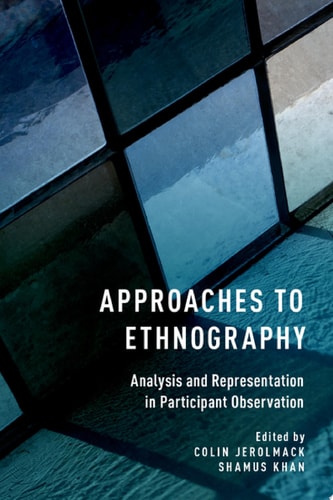
Approaches to Ethnography: Analysis and Representation in Participant Observation
0
0
As an Amazon Associate and affiliate partner, Menrva Books earns from qualifying purchases. Learn more
Author Description
No ethnographer can record and analyze everything that she encounters in the field. We must make choices about what to look at and how to look at it, which means privileging some aspects of social life while bracketing others. Approaches to Ethnography enumerates the key analytic strategies-which Jerolmack and Khan call approaches-that ethnographers deploy to tame the buzzing confusion of the social world. The book identifies eight approaches that typify ethnography, which it groups and compares along four axes: 1) Micro, organizational, and macro; 2) people and places, and mechanisms; 3) dispositions and situations; and 4) reflexivity. Each approach, it is shown, enables the illumination of a distinct dimension of the social world.Every chapter is written by a seasoned ethnographer who enumerates one of the approaches and reflects on how that approach shapes their field site selection, observations, and analysis. Taken as a whole, the chapters show how these approaches, which operate more like sensitizing devices than theoretical mandates, can play a greater role in guiding the kinds of questions that get asked and answered in the field than whether one adopts an inductive or deductive stance toward theory. Engaging, accessible, and often inspiring, Approaches to Ethnography offers a practical and novel way to teach, evaluate, and conceptualize ethnographic research.
Menrva's Summary
THE THESIS
This book investigates how ethnographers can effectively manage the overwhelming complexity of field observations by utilizing specific analytic strategies to focus their research. Authors Colin Jerolmack and Shamus Khan, both established sociologists, curate a collection of contributions from seasoned field researchers to provide a structured framework for ethnographic inquiry. They argue that these approaches function as sensitizing devices that guide the researcher's focus, ultimately shaping the questions asked and the data collected during fieldwork.
THE SCOPE MAP
What You Will Find
- A taxonomy of eight distinct ethnographic approaches categorized along four analytical axes.
- Comparative analysis of micro, organizational, and macro levels of social observation.
- Reflections from experienced ethnographers on how specific methods influence site selection and analysis.
Scope Limits
- The text does not provide a comprehensive history of ethnographic theory.
- It does not serve as a general introduction to basic fieldwork logistics or data collection techniques.
THE AUTHORITY PERSPECTIVE
Experts identify this work as a practical resource for graduate students and researchers looking to refine their methodological toolkit. Readers frequently note that the book successfully bridges the gap between abstract theory and the concrete realities of conducting field research.
Page Count:
286
Publication Date:
2017-11-20
Publisher:
Oxford University Press
ISBN-10:
0190236051
ISBN-13:
9780190236052
Research Methods
Social Science
Qualitative Research
Ethnography
Sociology
Academic
Community Tags
Similar Books