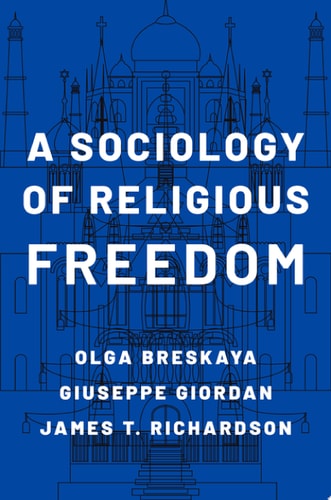
A Sociology of Religious Freedom
0
0
As an Amazon Associate and affiliate partner, Menrva Books earns from qualifying purchases. Learn more
Author Description
In recent years, the relevance of religious freedom has spread well beyond academia, becoming a reference point for international relations, multi-level policy development, as well as interfaith negotiations. Meanwhile, scholarship on religious freedom has flourished on the boundaries of sociology, law, comparative politics, history, and theology. This book presents a systematic sociological analysis of religious freedom, bringing together classical sociological theories and empirical perspectives developed during the last three decades. It addresses three major questions involved in any sociology of religious freedom. First: considering its complex and controversial nature, how can religious freedom be defined? Second: what are the recurrent sociological conditions and relevant social perceptions that will foster an understanding of religious freedom in varying political, legal, and socioreligious contexts? And third, what are the mechanisms of social implementation of religious freedom that contribute to making it a fundamental value in a society? Olga Breskaya, Giuseppe Giordan, and James T. Richardson suggest that a sociological definition of religious freedom requires us to take into account historical, philosophical, legal, religious, and political considerations of a given society-and that the social dimensions of religious freedom are as important as the legal ones.
Menrva's Summary
THE THESIS
This work investigates the sociological dimensions of religious freedom by examining how it functions as a fundamental value within diverse political, legal, and social frameworks. The authors, Giuseppe Giordan, James T. Richardson, and Olga Breskaya, synthesize classical sociological theory with three decades of empirical research to construct a comprehensive analytical model. They argue that religious freedom cannot be understood through legal definitions alone, but requires an interdisciplinary approach that accounts for the historical and socioreligious context of a given society. By addressing the definition, conditions, and implementation of this right, the text provides a structured methodology for analyzing religious freedom in contemporary international relations and policy.
THE SCOPE MAP
What You Will Find
- A systematic sociological analysis of religious freedom across varying political and legal contexts.
- Theoretical frameworks integrating classical sociology with modern empirical perspectives.
- Examination of the social mechanisms required for the implementation of religious freedom as a societal value.
- Comparative analysis of how religious freedom is perceived and negotiated in international and interfaith settings.
THE AUTHORITY PERSPECTIVE
Scholars and researchers in the fields of sociology and law identify this text as a significant contribution to the interdisciplinary study of religious rights. Readers frequently note the academic density of the prose, which serves as a foundational resource for those analyzing the intersection of social policy and religious practice.
Page Count:
312
Publication Date:
2024-09-27
Publisher:
Oxford University Press
ISBN-10:
0197533817
ISBN-13:
9780197533819
Politics
Religion
History
Church & State
Law
Human rights
Sociology
Community Tags
Similar Books