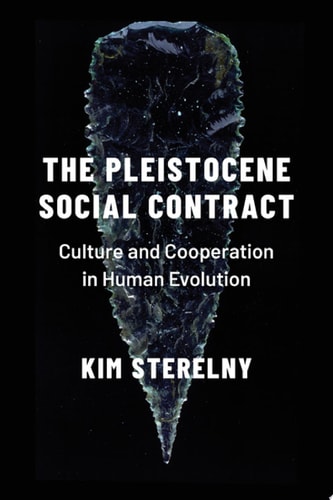
The Pleistocene Social Contract: Culture and Cooperation in Human Evolution
0
0
As an Amazon Associate and affiliate partner, Menrva Books earns from qualifying purchases. Learn more
Author Description
Kim Sterelny here builds on his original account of the evolutionary development and interaction of human culture and cooperation, which he first presented in The Evolved Apprentice (2012). Sterelny sees human evolution not as hinging on a single key innovation, but as emerging from a positive feedback loop caused by smaller divergences from other great apes, including bipedal locomotion, better causal and social reasoning, reproductive cooperation, and changes in diet and foraging style. He advances this argument in The Pleistocene Social Contract with four key claims about cooperation, culture, and their interaction in human evolution. First, he proposes a new model of the evolution of human cooperation. He suggests human cooperation began from a baseline that was probably similar to that of great apes, advancing about 1.8 million years ago to an initial phase of cooperative forging, in small mobile bands. Second, he then presents a novel account of the change in evolutionary dynamics of cooperation: from cooperation profits based on collective action and mutualism, to profits based on direct and indirect reciprocation over the course of the Pleistocene. Third, he addresses the question of normative regulation, or moral norms, for band-scale cooperation, and connects it to the stabilization of indirect reciprocation as a central aspect of forager cooperation. Fourth, he develops an account of the emergence of inequality that links inequality to intermediate levels of conflict and cooperation: a final phase of cooperation in largescale, hierarchical societies in the Holocene, beginning about 12,000 years ago. The Pleistocene Social Contract combines philosophy of biology with a reading of the archaeological and ethnographic record to present a new model of the evolution of human cooperation, cultural learning, and inequality.
Menrva's Summary
THE THESIS
This work investigates the evolutionary mechanisms that facilitated the transition from great ape-like social structures to the complex, cooperative, and hierarchical societies of modern humans. Kim Sterelny, a prominent philosopher of biology, synthesizes archaeological data, ethnographic records, and evolutionary theory to argue that human sociality emerged from a cumulative feedback loop rather than a single biological innovation. He posits that shifts in foraging, reproductive strategies, and cognitive reasoning created a unique trajectory for human cooperation that eventually stabilized through normative regulation and moral norms.
THE SCOPE MAP
What You Will Find
- A multi-phase model of human cooperation spanning from the early Pleistocene to the Holocene.
- An analysis of the transition from mutualism-based collective action to systems of direct and indirect reciprocation.
- A theoretical framework linking the emergence of social inequality to intermediate levels of conflict and cooperation.
- An interdisciplinary synthesis of philosophy of biology, archaeology, and ethnographic studies of forager societies.
THE AUTHORITY PERSPECTIVE
Experts recognize this text as a significant contribution to the ongoing debate regarding the origins of human social complexity and the evolution of moral norms. Readers frequently note the academic density of the prose, which requires a foundational understanding of evolutionary biology and anthropological theory to fully appreciate the author's arguments.
Page Count:
196
Publication Date:
2021-01-01
Publisher:
Oxford University Press
ISBN-10:
0197531407
ISBN-13:
9780197531402
Self-help
Philosophy
Sociology
Self Help
Cooperation
Evolutionary Biology
Mind & Body
Archaeology
Anthropology
Community Tags
Similar Books