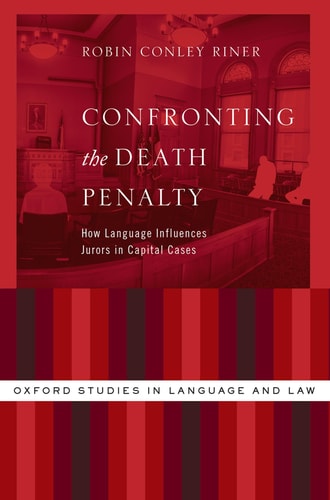
Confronting the Death Penalty: How Language Influences Jurors in Capital Cases
0
0
As an Amazon Associate and affiliate partner, Menrva Books earns from qualifying purchases. Learn more
Author Description
Confronting the Death Penalty: How Language Influences Jurors in Capital Cases probes how jurors make the ultimate decision about whether another human being should live or die. Drawing on ethnographic and qualitative linguistic methods, this book explores the means through which language helps to make death penalty decisions possible - how specific linguistic choices mediate and restrict jurors', attorneys', and judges' actions and experiences while serving and reflecting on capital trials.The analysis draws on fifteen months of ethnographic fieldwork in diverse counties across Texas, including participant observation in four capital trials and post-verdict interviews with the jurors who decided those cases. Given the impossibility of access to actual capital jury deliberations, this integration of methods aims to provide the clearest possible window into jurors' decision-making. Using methods from linguistic anthropology, conversation analysis, and multi-modal discourse analysis, Conley analyzes interviews, trial talk, and written legal language to reveal a variety of communicative practices through which jurors dehumanize defendants and thus judge them to be deserving of death.By focusing on how language can both facilitate and stymie empathic encounters, the book addresses a conflict inherent to death penalty trials: jurors literally face defendants during trial and then must distort, diminish, or negate these face-to-face interactions in order to sentence those same defendants to death. The book reveals that jurors cite legal ideologies of rational, dispassionate decision-making - conveyed in the form of authoritative legal language - when negotiating these moral conflicts. By investigating the interface between experiential and linguistic aspects of legal decision-making, the book breaks new ground in studies of law and language, language and psychology, and the death penalty.
Menrva's Summary
THE THESIS
This book investigates how specific linguistic practices and communicative strategies within the courtroom environment influence jurors' moral decision-making in capital punishment cases. Robin Conley Riner, a scholar in linguistic anthropology, utilizes fifteen months of ethnographic fieldwork conducted in Texas to examine the intersection of legal discourse and human psychology. By analyzing trial transcripts, judicial instructions, and post-verdict interviews, the author argues that authoritative legal language provides a framework that allows jurors to navigate the profound moral conflict of sentencing a defendant to death.
THE SCOPE MAP
What You Will Find
- Ethnographic data gathered from fifteen months of fieldwork in diverse Texas counties.
- Analysis of four capital trials including participant observation and post-verdict juror interviews.
- Application of linguistic anthropology, conversation analysis, and multi-modal discourse analysis to legal settings.
- Examination of how linguistic choices facilitate the dehumanization of defendants to justify capital sentencing.
THE AUTHORITY PERSPECTIVE
Experts identify this work as a significant contribution to the fields of law and language, offering a rare empirical look at the psychological mechanisms of capital juries. Readers frequently note the academic density of the prose, which is well-suited for scholars and practitioners interested in the intersection of rhetoric and judicial outcomes.
Page Count:
256
Publication Date:
2020-11-01
Publisher:
Oxford University Press
ISBN-10:
0197545548
ISBN-13:
9780197545546
Non-Fiction
Criminology
Sociology
Law
United States
Linguistics
Community Tags
Similar Books