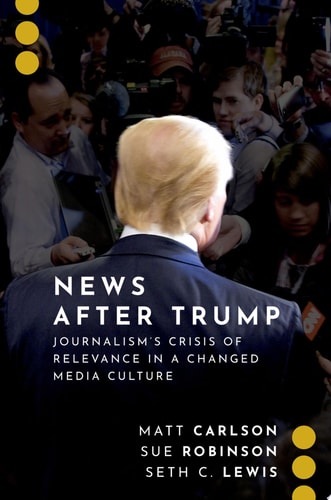
News After Trump: Journalism's Crisis of Relevance in a Changed Media Culture
0
0
As an Amazon Associate and affiliate partner, Menrva Books earns from qualifying purchases. Learn more
Author Description
Donald Trump might have been the loudest and most powerful voice maligning the integrity of news media in a generation, but his unrelenting attacks draw from a stew of resentment, wariness, cynicism, and even hatred toward the press that has been simmering for years. At one time, journalism's centrality in reporting and interpreting important events was relatively unquestioned when a limited number of channels and voices produced a consensus-based news environment. The collapse of this environment has sparked a moment of reckoning within and outside journalism, particularly as professional news outlets struggle to remain solvent. Alternative voices compete for attention with and criticize the work and motivations of journalists, even as a growing number of journalists question their core norms and practices. News After Trump considers these struggles over journalism to be about the very relevance of journalism as an institutional form of knowledge production. At the heart of this questioning is a struggle to define what truthful accounts look like and who ought to create them or determine them in a rapidly changing media culture. Through an extensive accounting of Trump's relationship with the press, and drawing on in-depth interviews with journalists and textual analysis of news events, editorials, social media, and trade-press discussions, the book rethinks the relevance of journalism by recognizing the limits of objectivity and the way in which journalism positions certain actors as authority figures while rendering the less socially powerful invisible or flawed. This ethos of detachment has staved off vital questions about how journalism connects to its audiences, how it creates enduring value in people's lives (or not), and how diversity needs to be understood jointly at the level of production, reporting, and audience in order to rebuild trust.
Menrva's Summary
THE THESIS
This book investigates the crisis of relevance facing contemporary journalism in an era defined by the erosion of consensus-based media and the rise of alternative information ecosystems. The authors, Matt Carlson, Seth C. Lewis, and Sue Robinson, utilize a framework of institutional knowledge production to analyze how professional news outlets struggle to maintain authority. By examining the intersection of political rhetoric, shifting audience expectations, and internal professional norms, the authors argue that journalism must move beyond traditional objectivity to rebuild public trust and demonstrate enduring value.
THE SCOPE MAP
What You Will Find
- Analysis of the historical collapse of consensus-based news environments.
- Examination of the relationship between political figures and the press.
- Qualitative data derived from in-depth interviews with working journalists.
- Methodological critique of traditional journalistic detachment and objectivity.
THE AUTHORITY PERSPECTIVE
Experts in media studies identify this work as a significant contribution to understanding the institutional challenges of modern news organizations. Readers frequently note the academic rigor of the analysis and its utility for those studying the intersection of political communication and digital media culture.
Page Count:
273
Publication Date:
2021-01-01
Publisher:
Oxford University Press
ISBN-10:
0197550371
ISBN-13:
9780197550373
Communication
Media Studies
Mass Communication
Sociology
Journalism
Comparative Politics
Community Tags
Similar Books





Reader Comments
Share Your Thoughts
No comments yet. Be the first to share your thoughts!