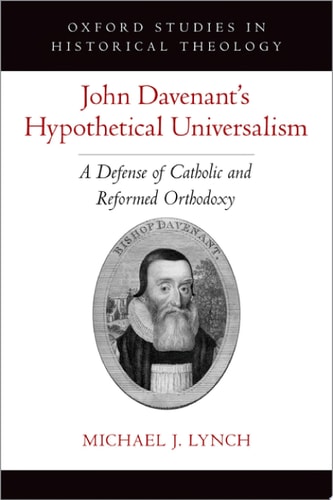
John Davenant's Hypothetical Universalism: A Defense of Catholic and Reformed Orthodoxy
0
0
As an Amazon Associate and affiliate partner, Menrva Books earns from qualifying purchases. Learn more
Author Description
Recently there has been a revival of interest in the views held by Reformed theologians within the parameters of confessional orthodoxy. For example, the doctrine known as 'hypothetical universalism'--the idea that although Christ died in some sense for every person, his death was intended to bring about the salvation only for those who were predestined for salvation. Michael Lynch focuses on the hypothetical universalism of the English theologian and bishop John Davenant (1572-1641), arguing that it has consistently been misinterpreted and misrepresented as a via media between Arminian and Reformed theology. A close examination of Davenent's De Morte Christi, is the central core of the study. Lynch offers a detailed exposition of Davenant's doctrine of universal redemption in dialogue with his understanding of closely related doctrines such as God's will, predestination, providence, and covenant theology. He defends the thesis that Davenant's version of hypothetical universalism represents a significant strand of the Augustinian tradition, including the early modern Reformed tradition. The book examines the patristic and medieval periods as they provided the background for the Lutheran, Remonstrant, and Reformed reactions to the so-called Lombardian formula ('Christ died sufficiently for all, effectually for the elect'). It traces how Davenant and his fellow British delegates at the Synod of Dordt shaped the Canons of Dordt in such a way as to allow for their English hypothetical universalism.
Menrva's Summary
THE THESIS
This work investigates whether John Davenant’s doctrine of hypothetical universalism constitutes a legitimate expression of Reformed orthodoxy rather than a departure from it. Michael J. Lynch, a scholar of early modern Reformed theology, utilizes primary source analysis of Davenant’s De Morte Christi to challenge the common perception that this doctrine serves as a middle ground between Arminianism and Calvinism. By situating Davenant within the broader Augustinian tradition, Lynch argues that this theological framework is consistent with the confessional standards of the seventeenth-century Reformed church.
THE SCOPE MAP
What You Will Find
- A detailed examination of the Lombardian formula regarding the sufficiency and efficacy of Christ's death.
- An analysis of the historical proceedings and influence of the British delegation at the Synod of Dordt.
- A comparative study of Davenant’s views on providence, predestination, and covenant theology.
- A historical survey of patristic and medieval theological foundations that informed early modern Reformed thought.
THE AUTHORITY PERSPECTIVE
Scholars and theologians recognize this text as a rigorous contribution to the study of seventeenth-century Reformed orthodoxy. Readers frequently note the academic density of the prose and the depth of the historical research provided by the author.
Page Count:
267
Publication Date:
2021-01-01
Publisher:
Oxford University Press
ISBN-10:
0197555160
ISBN-13:
9780197555163
Religion
History
Theology
Reformed Theology
Christianity
Historical Theology
Community Tags
Similar Books