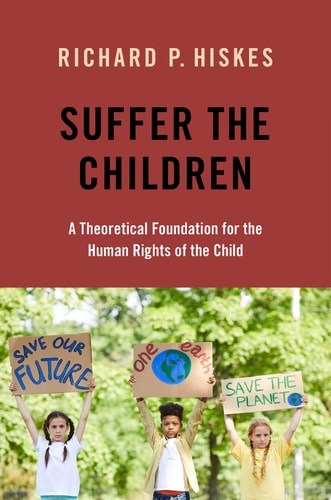
Suffer the Children: A Theoretical Foundation for the Human Rights of the Child
0
0
As an Amazon Associate and affiliate partner, Menrva Books earns from qualifying purchases. Learn more
Author Description
In 1973, Hillary Rodham Clinton famously stated that "children's rights" is a slogan in search of a definition, used to bolster various arguments for peace and for specific rights, but without any coherent conception of children as political beings. In 1989, the United Nations established the basis for this definition in the Convention on the Rights of the Child (CRC), a document every nation in the world, save the United States, has ratified. Still, human rights theorists, scholars, and jurists continue to disagree as to the theoretical justification for children's human rights. In Suffer the Children, Richard P. Hiskes establishes the first substantive theoretical foundation for the human rights of children. As Hiskes argues, recognizing the rights of children fundamentally alters the meaning and usefulness of human rights in a global context. Ironically, the case for children's rights, as Hiskes argues, should be seen as the evolution, distillation, or "maturing" of human rights in general. Children's human rights will end the debate about whether groups can have rights because, globally, many rights claims today are precisely group claims, including those from children. Moreover, Hiskes provides a new critical assessment of the United Nations CRC and explores child activism for human rights worldwide--in courts, on social networks, and in public demonstrations--to show how children are already claiming their rights in ways that will fundamentally change the meaning both of rights themselves and of democratic processes. Giving children rights in a way that avoids privileging any single cultural experience of children would make rights no longer a "Western," individualistic idea, but a truly global one.
Menrva's Summary
THE THESIS
This book investigates the theoretical justification for children's human rights, arguing that such a framework is necessary to evolve the broader understanding of human rights in a global context. Richard P. Hiskes, a scholar in political theory, utilizes the United Nations Convention on the Rights of the Child as a primary reference point to address the historical lack of a coherent definition for children as political beings. He posits that recognizing children's rights moves the discourse beyond Western individualistic models toward a more inclusive, global framework that accounts for group-based claims.
THE SCOPE MAP
What You Will Find
- A critical assessment of the United Nations Convention on the Rights of the Child.
- An analysis of child activism in global courts, social networks, and public demonstrations.
- A theoretical framework for reconciling individual rights with group-based claims.
- An exploration of how children's rights influence the evolution of democratic processes.
THE AUTHORITY PERSPECTIVE
Experts recognize this work as a significant contribution to the field of political theory and human rights law. Readers frequently note the academic density of the prose, which serves as a foundational text for those studying the intersection of childhood and international policy.
Page Count:
202
Publication Date:
2021-01-01
Publisher:
Oxford University Press
ISBN-10:
0197566014
ISBN-13:
9780197566015
Sociology
Public Policy
Law
Human rights
Community Tags
Similar Books