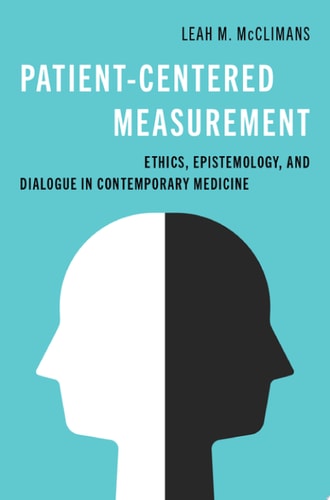
Patient-Centered Measurement: Ethics, Epistemology, and Dialogue in Contemporary Medicine
0
0
As an Amazon Associate and affiliate partner, Menrva Books earns from qualifying purchases. Learn more
Author Description
Contemporary medicine is Janus-faced. Evidence-based medicine is one face, emphasizing evidence, statistics, and method. Patient-centered care is the other, prioritizing patient experiences, judgement, and values. Government agencies, policy makers, major insurers and clinicians have sought ways to bring these approaches together, and the questionnaires that patients must fill out at the doctor's office or hospital are its most common manifestation. Leah M. McClimans examines one such integrative approach, patient-centered measurement.Patient-centered measurement is the idea that patient perspectives on, for instance, physical functioning or quality of life, should play an evidentiary role in determining how effective a drug is taken to be, the degree to which a hospital provides good quality care or whether a particular intervention should be funded by an insurer. Patient-centered measurement treats patient perspectives on par with more traditional metrics such as mortality, morbidity, and safety. But how can measurement, which relies on standardization, represent patient perspectives, which, if not idiosyncratic, are at least various and changeable? Leah M. McClimans investigates the history and philosophy of patient-centered measurement, examining the use and role of patient questionnaires, and explores how patient-centered measurement sits within the contemporary preoccupation with evidence-based medicine.
Menrva's Summary
THE THESIS
How can standardized measurement tools effectively capture the inherently subjective and variable nature of patient experiences within the framework of evidence-based medicine? Leah M. McClimans, a philosopher of medicine, investigates the epistemological and ethical tensions arising when patient-reported outcomes are integrated into clinical and policy decision-making. By analyzing the history and methodology of patient questionnaires, the author argues that the push for quantification in modern healthcare often conflicts with the nuanced, individualistic reality of patient values and quality-of-life assessments.
THE SCOPE MAP
What You Will Find
- Historical development of patient-reported outcome measures in clinical settings
- Philosophical critique of standardization versus individual patient perspective
- Analysis of the integration between evidence-based medicine and patient-centered care
- Examination of how insurers and government agencies utilize patient data for funding and quality assessment
THE AUTHORITY PERSPECTIVE
Experts in medical humanities and health policy recognize this work as a critical examination of the metrics currently shaping modern clinical practice. Readers frequently note the academic density of the prose, which provides a rigorous philosophical foundation for understanding the limitations of current patient-centered measurement tools.
Page Count:
256
Publication Date:
2024-01-01
Publisher:
Oxford University Press
ISBN-10:
0197572073
ISBN-13:
9780197572078
Philosophy
Politics
Ethics & Morality
Medicine
Healthcare Policy
Health Care
Ethics
Sociology
Medical Ethics
Community Tags
Similar Books