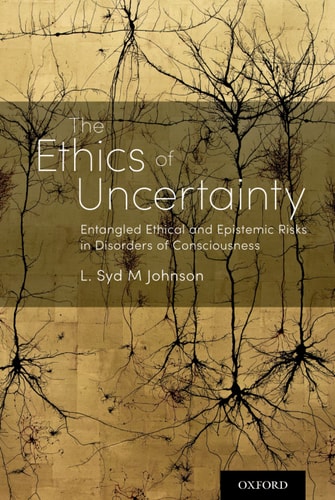
The Ethics of Uncertainty: Entangled Ethical and Epistemic Risks in Disorders of Consciousness
0
0
As an Amazon Associate and affiliate partner, Menrva Books earns from qualifying purchases. Learn more
Author Description
Disorders of Consciousness (DoCs) raise difficult and complex questions about the value of life for persons with impaired consciousness, the rights of persons unable to make medical decisions, and our social, medical, and ethical obligations to patients whose personhood has frequently been challenged and neglected. Recent neuroscientific discoveries have led to enhanced understanding of the heterogeneity of these disorders, and focused renewed attention on the medical and ethical problem of misdiagnosis. This book examines the entanglement of epistemic and ethical uncertainty in DoCs and other medical contexts, and how they interact to create both epistemic and ethical risks. Philosopher and bioethicist L. Syd M Johnson pulls together multiple threads in this work: the ontological mysteries of consciousness, medical uncertainty about unconsciousness, ableist bias, withdrawal of treatment in neurointensive care, and the rarely questioned view that consciousness is essential to personhood and moral status. Johnson challenges longstanding bioethical dogmas about DoC patients, and argues for an ethics of uncertainty for contexts where there is a need for decisive action in the presence of unavoidable uncertainty. The ethics of uncertainty refocuses ethical inquiry concerning persons with DoCs, placing less emphasis on their contested personhood, and more on inductive risk and uncertainty, on respect for autonomy, and especially on epistemic justice. With applications to various decisional contexts where uncertainty and ethical risk interact, this ethical approach enables surrogate decision makers facing fraught and risky choices to fulfill their obligations as moral and epistemic agents.
Menrva's Summary
THE THESIS
This book investigates how the entanglement of epistemic and ethical uncertainty complicates medical decision-making for patients with disorders of consciousness. L. Syd M. Johnson, a philosopher and bioethicist, utilizes a framework that bridges neuroscientific findings with moral philosophy to address the risks inherent in clinical settings. The author argues that traditional bioethical dogmas often fail to account for the reality of medical uncertainty, proposing instead an ethics of uncertainty that prioritizes epistemic justice and inductive risk management.
THE SCOPE MAP
What You Will Find
- Analysis of the intersection between ontological mysteries of consciousness and clinical misdiagnosis.
- Examination of ableist biases in neurointensive care and treatment withdrawal protocols.
- A proposed framework for surrogate decision-makers to navigate high-stakes medical choices.
Scope Limits
- The text does not provide a clinical manual for diagnosing specific neurological conditions.
- It does not offer a definitive resolution to the philosophical problem of what constitutes personhood.
THE AUTHORITY PERSPECTIVE
Experts in bioethics recognize this work as a significant contribution to the discourse on medical uncertainty and the moral status of vulnerable patients. Readers frequently note the academic density of the prose, which requires a foundational understanding of ethical theory to fully engage with the author's arguments.
Page Count:
300
Publication Date:
2021-01-01
Publisher:
Oxford University Press
ISBN-10:
019094367X
ISBN-13:
9780190943677
Philosophy
Medical
Medical Ethics
Epistemology
Allied Health
Medicine
Neuroscience
Bioethics
Community Tags
Similar Books