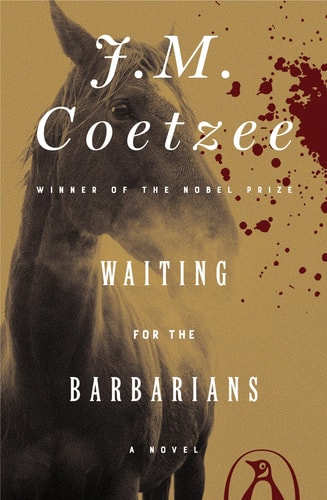
Waiting for the Barbarians
0
0
As an Amazon Associate and affiliate partner, Menrva Books earns from qualifying purchases. Learn more
Author Description
For decades the Magistrate has run the affairs of a tiny frontier settlement, ignoring the impending war between the barbarians and the Empire, whose servant he is. But when the interrogation experts arrive, he is jolted into sympathy with the victims and into a quixotic act of rebellion which lands him in prison as an enemy of the state.J.M. Coetzee's second prize-winning novel is an allegory of oppressor and oppressed. Not simply a man living through a crisis of conscience in an obscure place in remote times, the Magistrate is an analogue of all men living in complicity with regimes that ignore justice and decency.
Menrva's Summary
THE PULSE
The arrival of state security forces at a remote frontier settlement shatters the Magistrate's complacent existence, forcing him to confront the brutal reality of the Empire he serves. The protagonist, a long-serving administrator, finds his quiet life upended when he witnesses the systematic torture of prisoners by Colonel Joll. His subsequent attempt to protect a victim of this state violence leads to his own imprisonment and public humiliation. The narrative, presented in a detached first-person perspective, explores the logical collapse of a society built on fear and the physical isolation of a man caught between his duty and his conscience.
INSIDE THE PAGES
- First-person narrative perspective
- Allegorical exploration of colonial power dynamics
- Minimalist, precise prose style
- Focus on the psychological erosion of the protagonist
- Examination of the relationship between the oppressor and the oppressed
- Use of an unnamed, timeless setting to emphasize universal themes
- Exploration of the ethics of complicity
- Gradual shift from bureaucratic detachment to moral awakening
THE COLLECTIVE ECHO
Discussion often centers on the novel's stark, clinical prose and its ability to render complex political themes through a singular, isolated perspective. Readers frequently highlight the unsettling nature of the interrogation scenes, which serve as a catalyst for the Magistrate's internal conflict. Critics often note that the book functions as a timeless critique of authoritarianism, avoiding specific historical markers to emphasize the cyclical nature of imperial violence. The balance between the Magistrate's internal moral struggle and the external, encroaching threat of the Empire provides a steady, if somber, pacing that keeps the reader focused on the ethical implications of the narrative.
Page Count:
160
Publication Date:
1982-01-05
Publisher:
Penguin UK
ISBN-10:
0140065555
ISBN-13:
9780140065558
Dystopian
Literary Fiction
World Literature
Literary
Postcolonial
Political fiction
African
Allegory