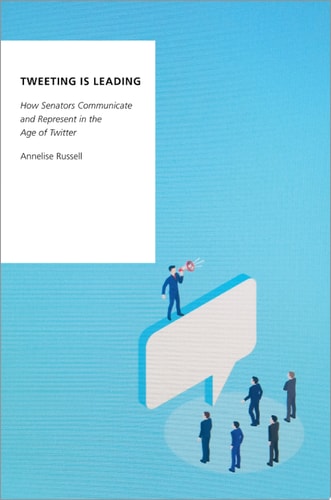
Tweeting is Leading: How Senators Communicate and Represent in the Age of Twitter
0
0
As an Amazon Associate and affiliate partner, Menrva Books earns from qualifying purchases. Learn more
Author Description
Social media is changing the business of representation in the Senate. If you want to know what your senator is up to, you don't need a newspaper, just your phone. Some senators are social media minimalists while others are digitally long-winded, but each senator has the ability to insert themselves into our daily digital routines and frame their political brand for a public audience. Drawing on a unique dataset of almost 200,000 senator tweets, Tweeting is Leading offers a critical analysis of senators' communication on Twitter, the individual and constituent forces that shape it, and the agendas that result. The public priorities that senators communicate through social media--what Annelise Russell calls their rhetorical agenda--offer a necessary tool for understanding how senators link their carefully crafted public image with potential voters. The rhetorical agenda challenges what we know about representation, removing the institutional and political constraints on congressional communication and giving lawmakers a messaging platform where individual discretion is high, the relative costs are low, and someone is always watching. Tweeting is Leading emphasizes why representation on social media matters for understanding media norms and how lawmakers digitally build a political brand, showing empirically how senators self-constrain their communications to curate different styles of representation that match constituent expectations.
Menrva's Summary
THE THESIS
How does the adoption of Twitter by United States senators alter the traditional dynamics of political representation and constituent communication? Annelise Russell, a scholar of political communication, investigates the shift in legislative messaging by analyzing a massive dataset of nearly 200,000 tweets. She argues that social media provides lawmakers with a low-cost, high-discretion platform to construct a 'rhetorical agenda' that bypasses traditional institutional constraints. By examining these digital patterns, the book demonstrates how senators curate specific political brands to align with the expectations of their constituents.
THE SCOPE MAP
What You Will Find
- A comprehensive dataset of nearly 200,000 tweets authored by U.S. senators.
- An analysis of the 'rhetorical agenda' as a tool for political branding and representation.
- Empirical evidence regarding how senators self-constrain their digital communication styles.
- A framework for understanding the intersection of media norms and legislative behavior.
THE AUTHORITY PERSPECTIVE
Experts in political science and digital media recognize this work as a significant contribution to the study of modern congressional communication. Scholars frequently cite the book for its empirical rigor and its ability to quantify the often-elusive strategies behind political social media usage.
Page Count:
277
Publication Date:
2021-01-01
Publisher:
Oxford University Press
ISBN-10:
019758229X
ISBN-13:
9780197582299
English & College Success
Communication
English
Sociology
United States
Social Media
Writing
Government
Community Tags
Similar Books