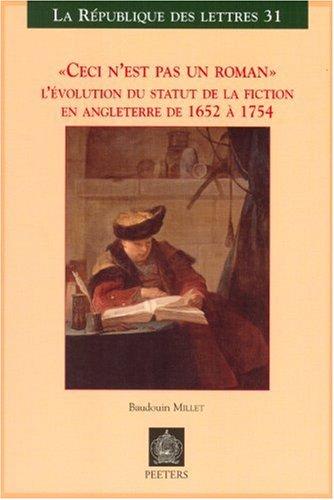
Ceci N'est Pas Un Roman
0
0
As an Amazon Associate and affiliate partner, Menrva Books earns from qualifying purchases. Learn more
Author Description
This study explores the theoretical discourses and rhetorical devices used by writers to legitimate fiction at a time when it was considered immoral by theologians and despised by scholars. The use of such discourses and devices is found in titles, prefaces and throughout the narratives themselves; they are employed to assert that the narratives contain moral truths or to assert their status as fact, thus rendering the narratives acceptable to the readership. The claim to factuality is asserted by the figure of the narrator-as-witness, who guarantees the veracity of the facts relayed, and, from 1700 onwards, by that of the manuscript editor. Following the publication of Henry Fielding's Joseph Andrews in 1742, the fiction of the period begins to flaunt its own fictionality, marking the emergence of self-reflexive fiction.
Menrva's Summary
THE THESIS
This study investigates the theoretical discourses and rhetorical devices employed by English-language fiction to establish its legitimacy amidst moral condemnation and scholarly disdain.
THE SCOPE MAP
- Analysis of theoretical discourses and rhetorical devices used to legitimate fiction.
- Examination of their deployment in titles, prefaces, and narrative content.
- Exploration of claims to moral truth and factual reporting within narratives.
- Discussion of the narrator-as-witness and manuscript editor figures.
- Focus on the emergence of self-reflexive fiction, exemplified by Henry Fielding's Joseph Andrews (1742).
THE AUTHORITY PERSPECTIVE
The study is likely to be of interest to scholars and students of literary theory, rhetoric, and English literary history. Its focus on the self-legitimization of fiction during a period of moral scrutiny suggests a dense, analytical approach. The detailed examination of specific rhetorical strategies and figures like the narrator-as-witness and manuscript editor points to a scholarly audience seeking a deep understanding of narrative construction and its historical context.
Page Count:
378
Publication Date:
2007-01-01
ISBN-10:
9042918527
ISBN-13:
9789042918528
Non-Fiction
Fiction
History
Literary History
English literature
Rhetoric
Literary Criticism
Community Tags
Similar Books