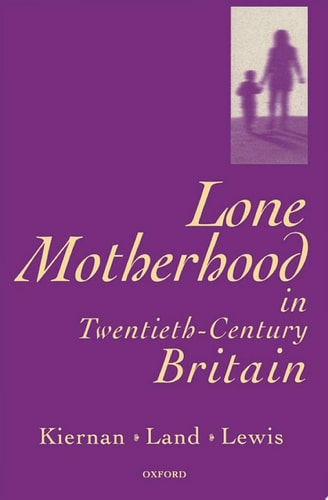
Lone Motherhood in Twentieth-Century Britain: From Footnote to Front Page
0
0
As an Amazon Associate and affiliate partner, Menrva Books earns from qualifying purchases. Learn more
Author Description
During the 1990s lone mothers reached the top of the political agenda, viewed as both a drain on public expenditure and a moral threat. What has been missing from the debate is an understanding of how we have got to where we are. This timely new study, by three leading experts in the field, sets out first to investigate the demographics of lone motherhood - how the pathways into lone motherhood have changed, and whether the changes of the last quarter of a century are as dramatic as they appear. Second, it looks at the wider context for the changes in lone motherhood in terms of ideas about marriage, and the changes in the construction of the never-married mother, from victim in the 1950s to parasite in the late 1980s. Finally, it examines the way in which policies have defined the problem of lone motherhood over time and the way in which lone mothers have been treated with regard to housing, social security, and employment. The study concludes that there is little possiblility of putting the genie back in the bottle in terms of reducing the number of lone mothers - efforts to do so by reducing public expenditure on them may be effective, but at the expense of the children involved. Instead, the authors urge policy-makers to change focus again, and pay more attention to investing in children.
Menrva's Summary
THE THESIS
This study investigates the historical evolution of lone motherhood in twentieth-century Britain to determine how shifting social, moral, and political frameworks transformed the status of single mothers from victims to perceived societal threats. The authors, Hilary Land, Jane Lewis, and Kathleen Kiernan, utilize demographic data and policy analysis to argue that the contemporary political focus on lone mothers as a fiscal burden ignores the complex historical trajectory of family structures and marriage norms. By examining the intersection of social security, housing, and employment policies, the authors provide a critical assessment of how state intervention has shaped the lives of these women and their children.
THE SCOPE MAP
What You Will Find
- Demographic analysis of pathways into lone motherhood across the twentieth century
- Historical overview of shifting societal attitudes toward marriage and single parenthood
- Examination of state policy impacts on housing, social security, and employment
- Comparative study of the construction of the never-married mother from the 1950s to the 1990s
Scope Limits
- The study focuses specifically on the British context and does not provide a comparative international analysis
- The research concludes its primary analysis in the late 1990s and does not cover subsequent twenty-first-century policy developments
THE AUTHORITY PERSPECTIVE
Experts recognize this work as a foundational text for understanding the intersection of social policy and family demographics in modern Britain. Readers frequently note the academic rigor and the clarity with which the authors connect historical policy shifts to contemporary political discourse.
Page Count:
347
Publication Date:
1998-01-01
Publisher:
OUP Oxford
ISBN-10:
0191037583
ISBN-13:
9780191037580
History
Indigenous
English literature
19th Century
Literary Criticism
Gender Studies
Single Mothers
Great Britain
Sociology
Demographics
Social policy
English poetry
British History
Family Studies
Community Tags
Similar Books