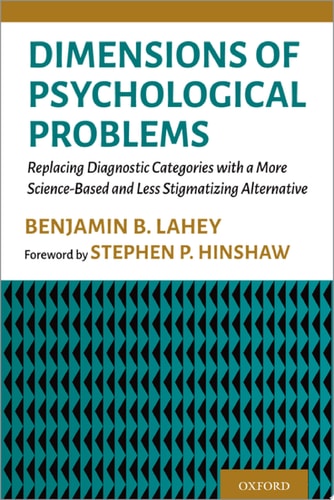
Dimensions of Psychological Problems: Replacing Diagnostic Categories with a More Science-Based and Less Stigmatizing Alternative
0
0
As an Amazon Associate and affiliate partner, Menrva Books earns from qualifying purchases. Learn more
Author Description
A remarkable and extremely important ongoing positive revolution in how we think about psychological problems is rapidly reaching a tipping point. This book provides a manifesto for this revolution. An increasing number of psychologists and psychiatrists are proposing that we either radically change the next edition of the Diagnostic and Statistical Manual of the Mental Disorders and the International Classification of Diseases or leave them behind entirely. The author argues for a view of psychological problems that is far less stigmatizing and better supported by the data but which will require large changes in thinking. First, there is no clear distinction between "normal" and "abnormal" psychological functioning. Psychological problems do not reflect rare and terrifying "illnesses" of the mind, but are problematic ways of thinking, feeling, and behaving that lie on continuous dimensions from minor to severe. Crucially, psychological problems are ordinary aspects of the human experience. They are ordinary in the sense of being commonplace-the great majority of us will experience distressing and disruptive psychological problems at some time during our lives-and are ordinary in arising through the same natural interplay of genetic and environmental influences as any other aspect of behavior. The dimensions of psychological problems are highly correlated and these correlations provide vital clues as that allow us to see a hierarchy of causes of psychological problems for the first time. These range from factors that influence the likelihood of exhibiting some kind of psychological problem, but not which kind, to highly specific causes.
Menrva's Summary
THE THESIS
This book investigates the necessity of replacing categorical diagnostic systems like the DSM and ICD with a dimensional model of psychological functioning. Benjamin B. Lahey, a prominent researcher in developmental psychopathology, utilizes current empirical data to argue that mental health issues exist on a spectrum rather than as discrete, stigmatizing illnesses. He posits that psychological problems are ordinary human experiences resulting from the same genetic and environmental interplay that shapes all behavior, advocating for a shift toward a hierarchical, data-driven understanding of mental health.
THE SCOPE MAP
What You Will Find
- A critique of traditional categorical diagnostic manuals including the DSM and ICD.
- A framework for understanding psychological problems as continuous dimensions rather than binary states.
- Analysis of the hierarchical structure of psychopathology based on correlated behavioral data.
- Evidence-based arguments regarding the genetic and environmental origins of mental health distress.
THE AUTHORITY PERSPECTIVE
Experts recognize this work as a significant contribution to the ongoing debate regarding the future of psychiatric classification. Readers frequently note the academic density of the prose, which serves as a foundational text for clinicians and researchers interested in the dimensional approach to mental health.
Page Count:
252
Publication Date:
2021-01-01
Publisher:
Oxford University Press
ISBN-10:
0197607926
ISBN-13:
9780197607923
Science
Non-Fiction
Psychology
Allied Health
Mental Health
Medical
Psychiatry
Psychotherapy
Community Tags
Similar Books