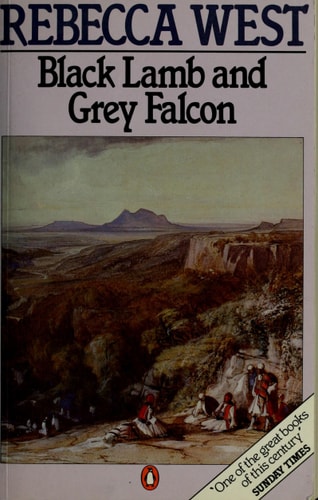
Black Lamb and Grey Falcon: A Journey Through Yugoslavia
0
0
As an Amazon Associate and affiliate partner, Menrva Books earns from qualifying purchases. Learn more
Author Description
Part travelogue, part history, part love letter on a thousand-page scale, Rebecca West's Black Lamb and Grey Falcon is a genre-bending masterwork written in elegant prose. But what makes it so unlikely to be confused with any other book of history, politics, or culture--with, in fact, any other book--is its unashamed depth of feeling: think The Decline and Fall of the Roman Empire crossed with Let Us Now Praise Famous Men. West visited Yugoslavia for the first time in 1936. What she saw there affected her so much that she had to return--partly, she writes, because it most resembled "the country I have always seen between sleeping and waking," and partly because "it was like picking up a strand of wool that would lead me out of a labyrinth in which, to my surprise, I had found myself immured." Black Lamb is the chronicle of her travels, but above all it is West following that strand of wool: through countless historical digressions; through winding narratives of battles, slavery, and assassinations; through Shakespeare and Augustine and into the very heart of human frailty.West wrote on the brink of World War II, when she was "already convinced of the inevitability of the second Anglo-German war." The resulting book is colored by that impending conflict, and by West's search for universals amid the complex particulars of Balkan history. In the end, she saw the region's doom--and our own--in a double infatuation with sacrifice, the "black lamb and grey falcon" of her title. It's the story of Abraham and Isaac without the last-minute reprieve: those who hate are all too ready to martyr the innocent in order to procure their own advantage, and the innocent themselves are all too eager to be martyred. To West, in 1941, "the whole world is a vast Kossovo, an abominable blood-logged plain." Unfortunately, little has happened since then to prove her wrong. --Mary Park
Menrva's Summary
THE THESIS
How do the historical, cultural, and political tensions of the Balkans reflect the broader, inevitable cycles of human conflict and self-destruction? Dame Rebecca West, a prominent journalist and novelist, utilizes her 1936 travels through Yugoslavia as a lens to examine the impending collapse of Europe on the eve of World War II. By synthesizing personal observation with exhaustive historical research, she argues that the region's history of sacrifice and violence serves as a microcosm for universal human frailty and the persistent allure of martyrdom.
THE SCOPE MAP
What You Will Find
- Detailed historical accounts of the Balkan region, including the significance of the Battle of Kosovo.
- Philosophical inquiries into the nature of sacrifice, nationalism, and political identity.
- First-hand observations of Yugoslavian culture, geography, and social structures during the late 1930s.
- Interdisciplinary analysis connecting literature, theology, and political history.
Scope Limits
- The text does not provide a neutral or objective journalistic account, as it is heavily filtered through the author's subjective, anti-fascist perspective.
- The narrative does not cover post-1941 developments in the region, focusing strictly on the pre-war context.
THE AUTHORITY PERSPECTIVE
Scholars and critics frequently identify this work as a foundational, albeit dense, text for understanding the complexities of Balkan history and the intellectual climate of the mid-twentieth century. Readers often note the prose is highly sophisticated and demanding, requiring significant patience to navigate the author's extensive historical digressions.
Page Count:
1181
Publication Date:
1982-11-18
Publisher:
Penguin Books
ISBN-10:
0140063552
ISBN-13:
9780140063554
Memoir
Travel
History
Politics
World politics
Politics & Government
Balkan Studies
Transportation
Travelogue
Community Tags
Similar Books