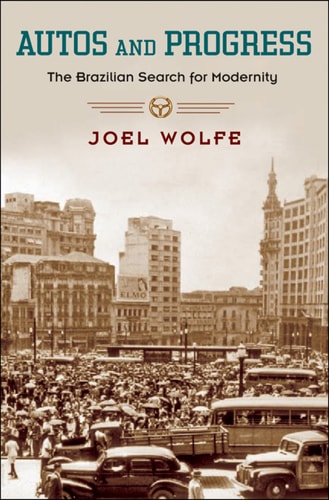
Autos and Progress: The Brazilian Search for Modernity
0
0
As an Amazon Associate and affiliate partner, Menrva Books earns from qualifying purchases. Learn more
Author Description
Autos and Progress reinterprets twentieth-century Brazilian history through automobiles, using them as a window for understanding the nation's struggle for modernity in the face of its massive geographical size, weak central government, and dependence on agricultural exports. Among the topics Wolfe touches upon are the first sports cars and elite consumerism; intellectuals' embrace of cars as the key for transformation and unification of Brazil; Henry Ford's building of a company town in the Brazilian jungle; the creation of a transportation infrastructure; democratization and consumer culture; auto workers and their creation of a national political party; and the economic and environmental impact of autos on Brazil. This focus on Brazilians' fascination with automobiles and their reliance on auto production and consumption as keys to their economic and social transformation, explains how Brazil--which enshrined its belief in science and technology in its national slogan of Order and Progress--has differentiated itself from other Latin American nations. Autos and Progress engages key issues in Brazil around the meaning and role of race in society and also addresses several classic debates in Brazilian studies about the nature of Brazil's great size and diversity and how they shaped state-making.
Menrva's Summary
THE THESIS
This work investigates how the automobile served as a central catalyst for Brazil's twentieth-century pursuit of modernization and national identity. Joel Wolfe, a historian specializing in Latin American labor and social history, utilizes the history of the car to examine the intersection of state-building, industrialization, and social change. He argues that the nation's reliance on automotive production and consumption reflects a unique attempt to reconcile its vast geography and diverse population with the global promise of technological progress.
THE SCOPE MAP
What You Will Find
- Analysis of the Fordlandia project and its implications for industrial development in the Amazon.
- Examination of the relationship between automotive labor unions and the emergence of national political movements.
- Discussion of the cultural shift from elite consumerism to mass-market democratization of the automobile.
- Evaluation of the environmental and economic consequences of prioritizing road-based infrastructure over other transit models.
THE AUTHORITY PERSPECTIVE
Scholars in the field of Brazilian studies recognize this text as a significant contribution to understanding how material culture shapes national policy and social hierarchy. Readers frequently note the author's ability to synthesize complex economic data with accessible cultural analysis, making it a foundational resource for those studying the intersection of technology and state-making in Latin America.
Page Count:
265
Publication Date:
2010-01-01
Publisher:
Oxford University Press
ISBN-10:
0199798745
ISBN-13:
9780199798742
History
Transportation
Progress
Sociology
Politics & Government
Nationalism
Automobile Industry And Trade
Social change
American History
Technology
Automobiles
Trades & Technology
Technology & Engineering
Economic History
Community Tags
Similar Books