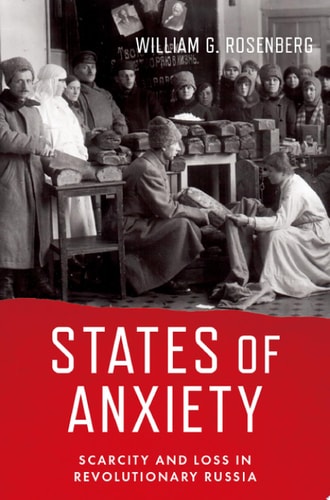
States of Anxiety: Scarcity and Loss in Revolutionary Russia
0
0
As an Amazon Associate and affiliate partner, Menrva Books earns from qualifying purchases. Learn more
Author Description
Amidst the vast literature on the parties and politics of revolutionary Russia and its near constant appropriation for presentist purposes over the years, States of Anxiety assesses the effects of the great scarcities and enormous losses that Russia experienced between 1914 and 1921, a period of dramatic civil conflicts and Russia's “long World War.” Scarcities meant not only the deficits of necessary goods like food, but also their accompanying anxieties and fears. Using archival documents and materials of the period almost exclusively, this study explores how the tsarist, democratic liberal, democratic socialist, and Bolshevik regimes all addressed the forms and effects of scarcity and loss in ways they hoped would assure the revolutionary outcomes of their own historical imaginations. Looking closely at their efforts, it suggests how and why each failed to do so.Approaching the Russian revolutionary period in these terms involves exploring a broad range of connected issues. Material scarcities involved problems with market exchange, prices, and inflation, as well as procurement, production, and distribution. They involved fiscal policies, monetary emissions, and the effects of escalating debt. But they also directly engaged cultural understandings of fairness, sacrifice, and social difference, and were accompanied by what today would be called today the anxieties of “food insecurity,” the dangerous risks of unemployment, and a range of fears about family and community welfare. Officials and members of various state and public committees of various political orientations faced both the threats and actualities of market collapse, rampant speculation, black markets, increasingly visible social inequalities, and an array of emotional fields whose implications need to be understood.The statistical and other objective dimensions of scarcity and loss are generally described in ways that omit their complex emotional dimension, as the language of “food insecurity” obscure
Menrva's Summary
THE THESIS
This study investigates how the pervasive material scarcities and profound losses experienced in Russia between 1914 and 1921 shaped the political failures of successive regimes. William G. Rosenberg, a distinguished historian of the Russian Revolution, utilizes an extensive array of primary archival documents to analyze the intersection of economic collapse and public anxiety. He argues that the tsarist, liberal, socialist, and Bolshevik governments all failed to manage these crises because they prioritized their own ideological visions over the practical realities of market failure and social insecurity.
THE SCOPE MAP
What You Will Find
- Analysis of the Russian revolutionary period spanning 1914 to 1921.
- Examination of fiscal policies, inflation, and the breakdown of market exchange systems.
- Investigation into the cultural and emotional dimensions of food insecurity and social inequality.
- Comparative study of how four distinct political regimes attempted to govern during systemic collapse.
THE AUTHORITY PERSPECTIVE
Scholars recognize this work as a significant contribution to the social history of the Russian Revolution by centering the lived experience of scarcity. Readers frequently note the academic density of the prose and the author's meticulous reliance on primary archival sources.
Page Count:
600
Publication Date:
2023-01-01
Publisher:
Oxford University Press
ISBN-10:
0197610153
ISBN-13:
9780197610152
History
Russian History
Social History
Economic History
New Used & Rental Textbooks
Russia
Community Tags
Similar Books