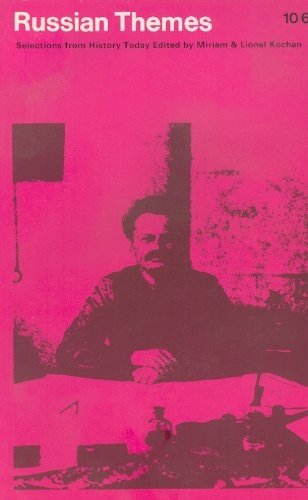
Russian Themes (History Today)
0
0
As an Amazon Associate and affiliate partner, Menrva Books earns from qualifying purchases. Learn more
Author Description
From 1703 to 1953, the period when Russia was adapting European science and culture to her changing needs, St. Petersburg became the microcosm of the turbulent nation. Alexander Radischev emerged as a founding figure in the liberal tradition of the Russian intelligentsia. Alexander I, Emperor of Russia, began his life as a liberal visionary and ended it as an impassioned champion of the autocratic principle. Under Alexander II, the Trans-Siberian Railway was begun. It is suggested that the abortive revolution of 1905 was the necessary prologue to the successful revolution of 1917. These themes and others are explored.
Menrva's Summary
THE THESIS
This work investigates the evolution of Russian political, social, and cultural identity from the founding of St. Petersburg in 1703 through the mid-twentieth century. Lionel Kochan, a noted historian of Russian affairs, examines the tension between European modernization and indigenous autocratic traditions. By analyzing key figures and infrastructure developments, the text argues that the internal contradictions of the Russian state served as the primary catalyst for the revolutionary shifts of the early twentieth century.
THE SCOPE MAP
What You Will Find
- Analysis of the liberal tradition within the Russian intelligentsia via Alexander Radischev
- Examination of the ideological transition of Alexander I from liberal visionary to autocrat
- Historical context regarding the construction of the Trans-Siberian Railway under Alexander II
- Argumentation linking the 1905 revolution to the 1917 Bolshevik uprising
Scope Limits
- The text does not provide a comprehensive military history of the period
- The analysis focuses primarily on political and intellectual history rather than social or economic statistics
THE AUTHORITY PERSPECTIVE
Historians recognize this work as a concise synthesis of the intellectual currents that defined Imperial and early Soviet Russia. Readers frequently note the clarity of the prose, which makes complex political transitions accessible to those studying the foundations of the Russian state.
Page Count:
144
Publication Date:
1967-01-01
Publisher:
Dufour Editions
ISBN-10:
0050009915
ISBN-13:
9780050009918
History
Russian History
European History
Political History
Russia
Intellectual History
Community Tags
Similar Books