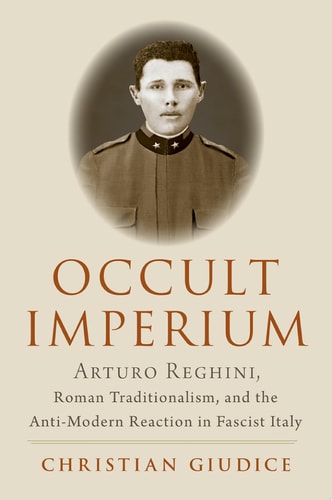
Occult Imperium: Arturo Reghini, Roman Traditionalism, and the Anti-Modern Reaction in Fascist Italy
0
0
As an Amazon Associate and affiliate partner, Menrva Books earns from qualifying purchases. Learn more
Author Description
Christian Giudice's Occult Imperium explores Italian national forms of Occultism, chiefly analyzing Arturo Reghini (1878-1946), his copious writings, and Roman Traditionalism. Trained as a mathematician at the prestigious University of Pisa, Reghini was one of the three giants of occult and esoteric thought in Italy, alongside his colleagues Julius Evola (1898-1974) and Giulian Kremmerz (1861-1930). Using Reghini's articles, books, and letters, as a guide, Giudice explores the interaction between occultism, Traditionalism, and different facets of modernity in early-twentieth-century Italy. The book takes into consideration many factors particular to the Italian peninsula: the ties with avant-garde movements such as the Florentine Scapigliatura and Futurism, the occult vogues typical to Italy, the rise to power of Benito Mussolini and Fascism, and, lastly, the power of the Holy See over different expressions of spirituality. Occult Imperium explores the convergence of new forms of spirituality in early twentieth-century Italy.
Menrva's Summary
THE THESIS
This work investigates the intersection of Italian occultism, Roman Traditionalism, and the political climate of early twentieth-century Italy through the life and intellectual output of Arturo Reghini. Christian Giudice, an academic researcher, utilizes a vast collection of Reghini's primary source materials—including correspondence, published articles, and books—to map the influence of esoteric thought on the broader anti-modern reaction. The text argues that Reghini’s synthesis of mathematics and mysticism provided a unique framework for understanding the spiritual and political tensions of the era, particularly in relation to the rise of Fascism and the influence of the Holy See.
THE SCOPE MAP
What You Will Find
- An analysis of the intellectual relationship between Arturo Reghini, Julius Evola, and Giulian Kremmerz.
- Historical context regarding the influence of the Florentine Scapigliatura and Futurism on Italian occult movements.
- An examination of the friction between esoteric spiritual practices and the institutional power of the Catholic Church.
- A detailed study of how occultism functioned as a critique of modernity within the context of Mussolini's Italy.
THE AUTHORITY PERSPECTIVE
Scholars of Western esotericism recognize this text as a rigorous examination of an often-overlooked niche in European intellectual history. Readers frequently note the academic density of the prose and the author's meticulous use of archival evidence to reconstruct the ideological landscape of the period.
Page Count:
340
Publication Date:
2021-01-01
Publisher:
Oxford University Press
ISBN-10:
0197610269
ISBN-13:
9780197610268
Religion
Biography
History
General Anthropology
Occultism
European History
Esotericism
Community Tags
Similar Books