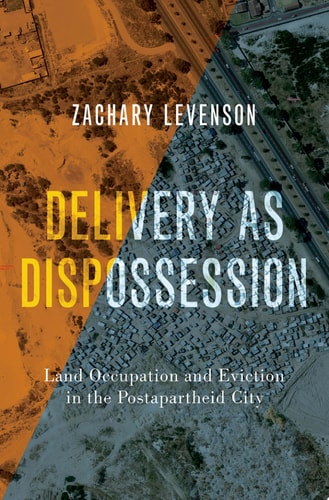
Delivery as Dispossession: Land Occupation and Eviction in the Postapartheid City
0
0
As an Amazon Associate and affiliate partner, Menrva Books earns from qualifying purchases. Learn more
Author Description
A sweeping historical and political analysis with detailed ethnographic fieldwork of the politics of everyday life in postcolonial Africa. In post-apartheid South Africa, nearly a fifth of the urban population lives in shacks. Unable to wait any longer for government housing, people occupy land, typically seeking to fly under the state's radar. Yet in most cases, occupiers wind up in dialogue with the state. In Delivery as Dispossession, Zachary Levenson follows this journey from avoidance to incorporation, explaining how the post-apartheid Constitution shifts squatters' struggles onto the judicial register. Providing a comparative ethnographic account of two land occupations in Cape Town and highlighting occupiers' struggles, Levenson further demonstrates why it is that housing officials seek the eviction of all new occupations: they view these unsanctioned settlements as a threat to the order they believe is required for delivery. Yet in evicting occupiers, he argues, they reproduce the problem anew, with subsequent rounds of land occupation as the inevitable consequence. Offering a unique framework for thinking about local states, this book proposes a novel theory of the state that will change the way ethnographers think about politics.
Menrva's Summary
THE THESIS
This book investigates the paradox of state-led housing delivery in post-apartheid South Africa, where the attempt to manage land occupations through judicial processes frequently results in further dispossession. Zachary Levenson, a sociologist specializing in urban politics, utilizes extensive ethnographic fieldwork conducted in Cape Town to analyze the friction between informal land occupiers and municipal authorities. He argues that the constitutional framework intended to facilitate housing delivery instead forces squatters into a cycle of legal confrontation, which ultimately undermines the state's own objectives.
THE SCOPE MAP
What You Will Find
- Comparative ethnographic analysis of two distinct land occupations in Cape Town.
- A theoretical framework examining the local state's role in managing informal settlements.
- Primary source interviews with both land occupiers and housing officials.
- An exploration of the judicialization of housing struggles under the post-apartheid Constitution.
THE AUTHORITY PERSPECTIVE
Scholars in urban sociology and African studies identify this work as a significant contribution to the understanding of state-society relations in postcolonial contexts. Readers frequently note the academic density of the prose and the rigor of the author's ethnographic methodology.
Page Count:
293
Publication Date:
2022-01-01
Publisher:
Oxford University Press
ISBN-10:
019762927X
ISBN-13:
9780197629277
Africa
Ethnic Studies
Human Geography
Earth Sciences
Sociology
Urban Studies
Comparative Politics
Rural
Ethnography
Community Tags
Other Editions(2)
Similar Books