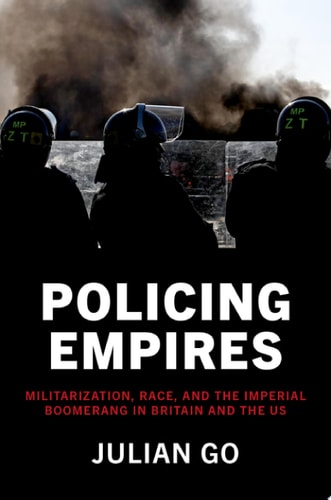
Policing Empires: Militarization, Race, and the Imperial Boomerang in Britain and the US
0
0
As an Amazon Associate and affiliate partner, Menrva Books earns from qualifying purchases. Learn more
Author Description
The police response to protests erupting on America's streets in recent years has made the militarization of policing painfully transparent. Yet, properly demilitarizing the police requires a deeper understanding of its historical development, causes, and social logics. Policing Empires offers a postcolonial historical sociology of police militarization in Britain and the United States to aid that effort. Julian Go tracks when, why, and how British and US police departments have adopted military tactics, tools, and technologies for domestic use. Go reveals that police militarization has occurred since the very founding of modern policing in the nineteenth century into the present, and that it is an effect of the "imperial boomerang." Policing Empires thereby unlocks the dirty secret of police militarization: Police have brought imperial practices home to militarize themselves in response to perceived racialized threats from minority and immigrant populations.
Menrva's Summary
THE THESIS
This work investigates the historical origins and social logic behind the militarization of police forces in Britain and the United States. Julian Go, a professor of sociology, utilizes a postcolonial historical framework to argue that police militarization is not a recent phenomenon but a long-standing consequence of the 'imperial boomerang.' He posits that domestic police departments have consistently adopted military tactics and technologies to manage perceived racialized threats from marginalized populations, effectively importing imperial control methods into domestic governance.
THE SCOPE MAP
What You Will Find
- A historical analysis of police development from the nineteenth century to the present day.
- A comparative study of institutional practices in both Britain and the United States.
- An examination of the 'imperial boomerang' concept as a mechanism for domestic policy shifts.
- Evidence linking the adoption of military-grade technology to the policing of immigrant and minority communities.
THE AUTHORITY PERSPECTIVE
Scholars and sociologists recognize this text as a significant contribution to the study of state power and institutional racism. Readers frequently note the academic rigor of the historical research and the clarity with which the author connects colonial history to contemporary domestic policing issues.
Page Count:
392
Publication Date:
2023-09-05
Publisher:
Oxford University Press
ISBN-10:
0197621651
ISBN-13:
9780197621653
History
Sociology
Criminology
Community Tags
Similar Books