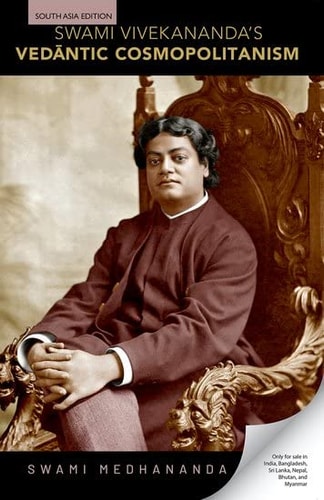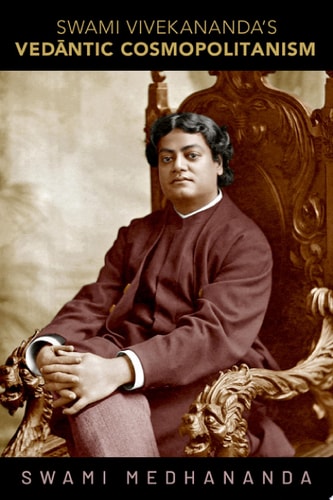
Swami Vivekananda's Vedantic Cosmopolitanism
0
0
As an Amazon Associate and affiliate partner, Menrva Books earns from qualifying purchases. Learn more
Author Description
Swami Vivekananda, the nineteenth-century Hindu monk who introduced Vedanta to the West, is undoubtedly one of modern India's most influential philosophers. Unfortunately, his philosophy has too often been interpreted through reductive hermeneutic lenses. Typically, scholars have viewed him either as a modern-day exponent of Sankara's Advaita Vedanta or as a "Neo-Vedantin" influenced more by Western ideas than indigenous Indian traditions. In Swami Vivekananda's Vedāntic Cosmopolitanism, Swami Medhananda rejects these prevailing approaches to offer a new interpretation of Vivekananda's philosophy, highlighting its originality, contemporary relevance, and cross-cultural significance. Vivekananda, the book argues, is best understood as a cosmopolitan Vedantin who developed novel philosophical positions through creative dialectical engagement with both Indian and Western thinkers. Inspired by his guru Sri Ramakrishna, Vivekananda reconceived Advaita Vedanta as a nonsectarian, life-affirming philosophy that provides an ontological basis for religious cosmopolitanism and a spiritual ethics of social service. He defended the scientific credentials of religion while criticizing the climate of scientism beginning to develop in the late nineteenth century. He was also one of the first philosophers to defend the evidential value of supersensuous perception on the basis of general epistemic principles. Finally, he adopted innovative cosmopolitan approaches to long-standing philosophical problems. Bringing him into dialogue with numerous philosophers past and present, Medhananda demonstrates the sophistication and enduring value of Vivekananda's views on the limits of reason, the dynamics of religious faith, and the hard problem of consciousness.
Menrva's Summary
THE THESIS
This book investigates whether Swami Vivekananda’s philosophical contributions have been mischaracterized by reductive academic frameworks that categorize him solely as a traditionalist or a Westernized derivative. Swami Medhananda, a scholar within the Ramakrishna Order, utilizes a rigorous comparative methodology to re-evaluate Vivekananda’s work. By situating the monk’s writings within both Indian and Western intellectual traditions, the author argues that Vivekananda functioned as a cosmopolitan philosopher who synthesized diverse ontological and ethical perspectives into a coherent, original system.
THE SCOPE MAP
What You Will Find
- A re-examination of Advaita Vedanta as a nonsectarian and life-affirming framework.
- Analysis of Vivekananda’s defense of supersensuous perception through general epistemic principles.
- Comparative studies placing Vivekananda in dialogue with both classical Indian thinkers and contemporary Western philosophers.
- An exploration of the intersection between religious faith, the limits of human reason, and the philosophy of consciousness.
THE AUTHORITY PERSPECTIVE
Scholars and students of Indian philosophy recognize this work as a significant intervention in the study of modern Hindu thought. Readers frequently note the academic density of the prose, which effectively challenges long-standing scholarly assumptions regarding Vivekananda’s intellectual independence.
Page Count:
428
Publication Date:
2021-01-01
Publisher:
Oxford University Press
ISBN-10:
0197624480
ISBN-13:
9780197624487
Philosophy
History
Religion
Biography
Hinduism
Mind & Body
Eastern
Hindu