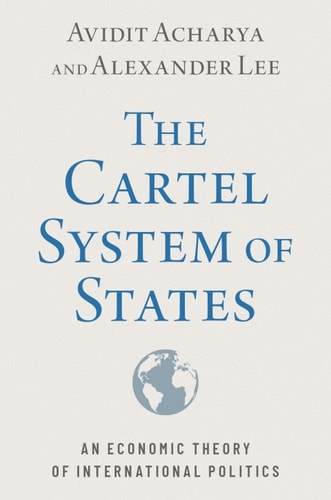
The Cartel System of States: An Economic Theory of International Politics
0
0
As an Amazon Associate and affiliate partner, Menrva Books earns from qualifying purchases. Learn more
Author Description
The people who live in border towns often have closer relations with people across their immediate borders than with people in the same country as them. Despite how intertwined these border communities often are, neither community can access the governmental institutions of the nation on the other side. Why are the citizens of neighboring regions that lie across an international border often subject to very different governance systems? More broadly, why can't public services be bought piecemeal, on an a-la-carte basis, with governments competing to provide higher quality services at the lowest cost in a marketplace for government services? These questions lie at the heart of modern International Relations.In The Cartel System of States, Avidit Acharya and Alexander Lee provide a powerful and field-shaping theory to address a fundamental issue in world politics: the character of the territorial nation-state. They contend that the modern territorial state system works as an economic cartel in which states have local, bounded monopolies in governing their citizens. States refuse to violate each other's monopolies, even when they could do so easily. Acharya and Lee examine what makes this system stable, when and how it emerged, how it spread, how it has been challenged, and what led it to be so resilient over time. Drawing from the centuries long process of modern state formation, The Cartel System of States explains both how the present system of territorial states--by no means a foregone conclusion in retrospect--took over the world and how it might change in the future.
Menrva's Summary
THE THESIS
This book investigates why the modern territorial nation-state persists as a global standard despite the potential for more efficient, competitive models of governance. Authors Alexander Lee and Avidit Acharya utilize economic theory to argue that the international state system functions as a cartel, wherein states maintain bounded monopolies over their populations and mutually agree to respect these borders. By analyzing the historical development of state formation, the authors demonstrate how this cartel-like structure has achieved remarkable resilience and global dominance over several centuries.
THE SCOPE MAP
What You Will Find
- An economic framework analyzing states as entities operating within a cartel system.
- Historical analysis of the emergence and spread of the territorial state model.
- Examination of the mechanisms that ensure state cooperation and the avoidance of territorial encroachment.
- Theoretical projections regarding the future stability and potential evolution of the current international order.
THE AUTHORITY PERSPECTIVE
Experts recognize this work as a significant contribution to the intersection of political science and economic theory. Scholars frequently note the rigor of the authors' arguments and the clarity with which they apply market-based concepts to the study of international relations.
Page Count:
221
Publication Date:
2022-01-01
Publisher:
Oxford University Press
ISBN-10:
0197632297
ISBN-13:
9780197632291
Economics
History
International relations
Political Theory
Community Tags
Similar Books