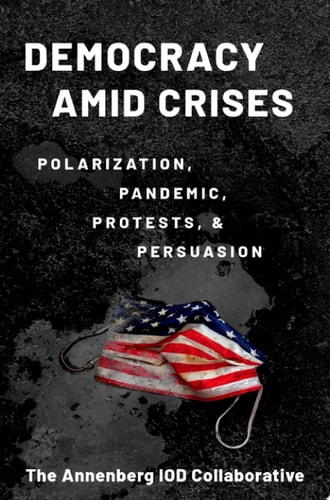
Democracy amid Crises: Polarization, Pandemic, Protests, and Persuasion
0
0
As an Amazon Associate and affiliate partner, Menrva Books earns from qualifying purchases. Learn more
Author Description
A data-rich analysis of how the four inter-related crises of 2020 -- the COVID-19 pandemic, the economic collapse and K-shaped recovery, the clashes over the legacy of racism and policing, and assaults on the legitimacy of democratic institutions (abetted by conspiracy theories) -- shaped not only the 2020 election, but also the future of our democracy.The 2020 election cycle was one of the most tumultuous in the nation's history. Early in the cycle, a global pandemic hit the US, paralyzing much of the economy and raising a multitude of questions about how people would go about voting. Then, beginning in late spring, a series of police brutality cases set off a nationwide wave of protests and civil disturbances related to racial justice concerns. In the final phase, the president of the United States refused to accept the results and incited his followers to storm the US Capitol. How did all of these momentous events shape voters' opinions? And what impact did they have on the outcome?To answer these questions, Kathleen Hall Jamieson and her collaborators surveyed 9,000 Americans over the course of the year to determine how voters reacted to the events on the ground, the campaigns' attempts at persuasion, and the post-election chaos that followed Biden's victory. Generally, American voters saw the multitude of crises through the lens of their polarized partisan predispositions. But why? Jamieson and her co-authors first stress that America has multiple electorates, and they are exposed to different informational environments. The divergent messages they received shaped not only their vote choice, but also how they made sense of these crises. Interestingly, though, while many voters were locked in place by their partisan priors, a majority of those who ended up voting for either Biden or Trump were unsure of their choice and whether they would actually vote at some point during the year. What led to both the wavering in people's choices and the attitudes they eventua
Menrva's Summary
THE THESIS
This book investigates how the convergence of the COVID-19 pandemic, economic instability, racial justice protests, and challenges to democratic legitimacy during 2020 fundamentally altered the American electoral landscape. The authors, a team of researchers led by Kathleen Hall Jamieson, utilize a comprehensive longitudinal survey of 9,000 Americans to analyze how voters navigated these crises. They argue that polarized informational environments and partisan predispositions dictated how citizens interpreted these events, while simultaneously identifying the specific factors that influenced wavering voters throughout the election cycle.
THE SCOPE MAP
What You Will Find
- Longitudinal survey data collected from 9,000 American participants throughout the 2020 election cycle.
- Analysis of the impact of divergent media environments on voter perception and decision-making.
- Examination of the relationship between partisan identity and the interpretation of crises such as the pandemic and civil unrest.
- Evaluation of how campaign persuasion efforts interacted with voter uncertainty during a period of national volatility.
THE AUTHORITY PERSPECTIVE
Experts recognize this work as a significant empirical contribution to the study of American political behavior during periods of extreme instability. The text is noted for its rigorous data-driven approach, providing a foundational analysis for scholars interested in the intersection of media, polarization, and democratic resilience.
Page Count:
484
Publication Date:
2023-01-13
Publisher:
Oxford University Press
ISBN-10:
0197644694
ISBN-13:
9780197644690
History
United States
Sociology
Democracy
Current Events
Community Tags
Similar Books






Reader Comments
Share Your Thoughts
No comments yet. Be the first to share your thoughts!