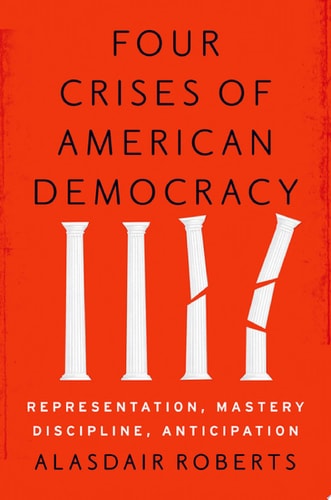
Four Crises of American Democracy: Representation, Mastery, Discipline, Anticipation
0
0
As an Amazon Associate and affiliate partner, Menrva Books earns from qualifying purchases. Learn more
Author Description
In the last decade, observers of Western governments have become increasingly concerned about an apparent crisis of democracy. They argue that endemic corruption, inadequate services, and increasing voter disaffection have produced a dire result: a global resurgence of authoritarianism. The political climate surrounding the 2016 presidential election in the United States has only reinforced the perception of democratic crisis.In Four Crises of American Democracy, Alasdair Roberts locates the U.S.'s recent bout of democratic malaise in a larger context, arguing that it is the latest in a series of very different crises that have plagued America throughout the entire post-Civil War era. He focuses on four crises, describing the features of each and outlining solutions the government adopted in response. The first crisis-the "crisis of representation"-occurred in the late nineteenth and early twentieth centuries, and was dominated by fears of plutocracy and debates about the rights of African Americans, women, and immigrants. The "crisis of mastery" spanned the years 1917-1948, and focused on building administrative capabilities so that government could better manage both an increasingly complex economy and volatile international system. The "crisis of discipline," beginning in the 1970s, was triggered by the perception that voters and special interests were overloading governments with unreasonable demands, and the response was to limit government's reach. The current crisis, what Roberts calls the "crisis of anticipation," is ongoing. Roberts pronounces it a future-oriented crisis, preoccupied with the capacity of democratic systems to deal with long-term problems such the rise of China and climate change.Roberts suggests that democratic solutions to this present crisis will win out over more authoritarian ones, as occurred in previous crises. Features like societal openness and pragmatism give the democratic model a distinct advantage. A powerful account of how succ
Menrva's Summary
THE THESIS
This book investigates whether the current perceived malaise in American democracy is an unprecedented collapse or a recurring pattern of institutional adaptation. Alasdair Roberts, a professor of public policy, utilizes historical analysis of the post-Civil War era to argue that American democracy has successfully navigated previous systemic shocks. He posits that the current period of instability is the fourth in a series of distinct crises, each requiring specific structural adjustments to maintain the viability of the democratic model.
THE SCOPE MAP
What You Will Find
- Historical analysis of four distinct democratic crises: representation, mastery, discipline, and anticipation.
- Examination of institutional responses to economic complexity and international volatility.
- Comparative study of how democratic systems manage long-term threats like climate change and geopolitical shifts.
Scope Limits
- The text focuses primarily on the United States and does not provide a comprehensive global history of democracy.
- It does not offer a predictive model for the specific outcome of the current crisis, focusing instead on historical patterns of adaptation.
THE AUTHORITY PERSPECTIVE
Scholars and political analysts frequently note the book's utility in providing a long-term historical framework for contemporary political anxiety. Experts highlight this as a balanced, non-alarmist contribution to the study of American institutional resilience.
Page Count:
280
Publication Date:
2017-01-10
Publisher:
Oxford University Press
ISBN-10:
0190459891
ISBN-13:
9780190459895
Public Policy
Sociology
American History
Government
Democracy
United States
Community Tags
Similar Books