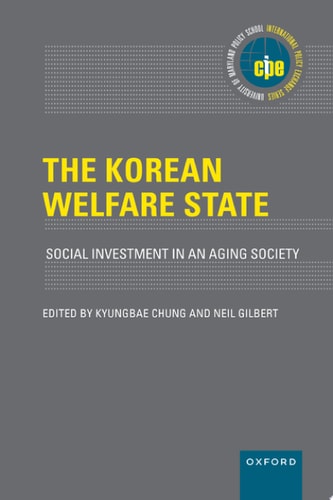
The Korean Welfare State: Social Investment in an Aging Society
0
0
As an Amazon Associate and affiliate partner, Menrva Books earns from qualifying purchases. Learn more
Author Description
The birth and remarkable expansion of Korean social welfare policy over the last several decades has taken place amidst the socio-economic burdens of a rapidly aging society. This book surveys these developments through the analytic lens of the Social Investment State, under which contemporary policies have altered the essential character of the 20th century welfare states, which had provided a counterforce to capitalism. In contrast, the Social Investment State is seen as backing policies designed to advance capitalism by promoting labor force participation, the growth of human capital, individual responsibility and economic development. In examining the modern context and development of the Korean welfare state, this book is divided into three sections that focus on the socio-political evolution, the core policies of the Korean welfare state, and the contemporary policy challenges of Korea's aging society. The first section traces the socio-political evolution of the Korean welfare state over the last three decades. The second section surveys the core policies of the Korean welfare state. The third section explores several key policy challenges encountered by the Korean approach to social investment as it seeks to address the demands of social protection in a rapidly aging society. The volume concludes with a postscript that reviews the contemporary Korean discourse, which goes beyond the social investment state to the political interests in a universal basic income policy.
Menrva's Summary
THE THESIS
This book investigates how the Korean welfare state has transitioned toward a Social Investment model to address the economic and social pressures of a rapidly aging population. The authors, Neil Gilbert and Kyungbae Chung, utilize a comparative policy framework to analyze how South Korea has shifted from traditional welfare structures to policies that prioritize labor force participation and human capital development. By examining the socio-political evolution of these systems, the text argues that contemporary Korean policy is increasingly designed to support capitalist growth while managing the demands of an older demographic.
THE SCOPE MAP
What You Will Find
- A historical analysis of the socio-political evolution of Korean welfare policy over the last thirty years.
- An examination of the Social Investment State framework and its application to modern economic development.
- A detailed survey of core social policies including labor market integration and human capital investment.
- A critical review of contemporary policy challenges, including the emerging discourse on universal basic income.
THE AUTHORITY PERSPECTIVE
Experts identify this volume as a primary resource for understanding the unique trajectory of East Asian social policy in the 21st century. Readers frequently note the academic density of the prose, which provides a rigorous examination of the intersection between state-led capitalism and social protection.
Page Count:
240
Publication Date:
2024-01-01
Publisher:
Oxford University Press
ISBN-10:
0197644929
ISBN-13:
9780197644928
Economics
Social Welfare
Sociology
Public Policy
Korea
Community Tags
Similar Books