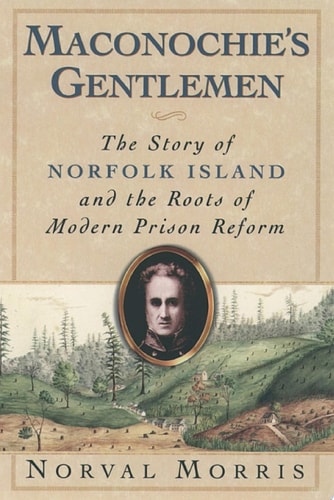
Maconochie's Gentlemen: The Story of Norfolk Island and the Roots of Modern Prison Reform
0
0
As an Amazon Associate and affiliate partner, Menrva Books earns from qualifying purchases. Learn more
Author Description
In 1840, Alexander Maconochie, a privileged retired naval captain, became at his own request superintendent of two thousand twice-convicted prisoners on Norfolk Island, a thousand miles off the coast of Australia. In four years, Maconochie transformed what was one of the most brutal convict settlements in history into a controlled, stable, and productive environment that achieved such success that upon release his prisoners came to be called "Maconochie's Gentlemen". Here Norval Morris, one of our most renowned criminologists, offers a highly inventive and engaging account of this early pioneer in penal reform, enhancing Maconochie's life story with a trenchant policy twist. Maconochie's life and efforts on Norfolk Island, Morris shows, provide a model with profound relevance to the running of correctional institutions today. Using a unique combination of fictionalized history and critical commentary, Morris gives this work a powerful policy impact lacking in most standard academic accounts. In an era of "mass incarceration" that rivals that of the settlement of Australia, Morris injects the question of humane treatment back into the debate over prison reform. Maconochie and his "Marks system" played an influential role in the development of prisons; but for the last thirty years prison reform has been dominated by punitive and retributive sentiments, the conventional wisdom holding that we need 'supermax' prisons to control the 'worst of the worst' in solitary and harsh conditions. Norval Morris argues to the contrary, holding up the example of Alexander Maconochie as a clear-cut alternative to the "living hell" of prison systems today.
Menrva's Summary
THE THESIS
Can the nineteenth-century penal experiments of Alexander Maconochie on Norfolk Island provide a viable framework for addressing the contemporary crisis of mass incarceration? Norval Morris, a distinguished criminologist, utilizes the historical record of Maconochie’s tenure as superintendent of a brutal convict settlement to challenge modern punitive correctional policies. By blending historical narrative with critical policy analysis, Morris argues that the 'Marks system'—which prioritized rehabilitation and individual responsibility—offers a necessary alternative to the current reliance on retributive supermax facilities.
THE SCOPE MAP
What You Will Find
- Historical analysis of the Norfolk Island penal colony during the 1840s.
- Detailed explanation of the 'Marks system' and its implementation.
- Comparative study between nineteenth-century convict management and modern mass incarceration trends.
Scope Limits
- The text does not provide a comprehensive biography of Maconochie outside of his specific penal reform efforts.
- It does not offer a technical manual for modern prison administration but rather a conceptual argument for policy shifts.
THE AUTHORITY PERSPECTIVE
Experts in criminology and legal history frequently cite this work as a bridge between historical penal theory and modern policy debates. Readers often note the unique hybrid structure of the text, which balances academic rigor with a narrative approach to historical reform.
Page Count:
229
Publication Date:
2003-01-01
Publisher:
Oxford University Press
ISBN-10:
0190290757
ISBN-13:
9780190290757
History
Biography
Professional Career & Trade
Public Policy
Penal Colonies
Criminology
Social Science
New Zealand
Prison Reform
Norfolk Island