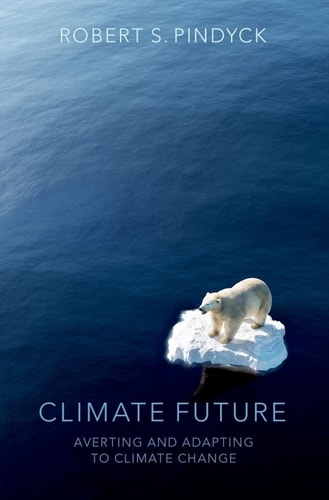
Climate Future: Averting and Adapting to Climate Change
0
0
As an Amazon Associate and affiliate partner, Menrva Books earns from qualifying purchases. Learn more
Author Description
Most people would probably agree on what should be done to avert severe climate change: The world must reduce CO2 emissions as much and as quickly as possible. But we must also ask what will be done. Is it realistic to expect worldwide emissions to fall rapidly enough to prevent severe climate change? And if we conclude it is not realistic, and so higher temperatures and rising sea levels are likely, what should we do? What actions should we take now to reduce the likely impact of climate change? Whatever climate policies are adopted, there will be a great deal of uncertainty over what will happen as a result. In Climate Future, Robert Pindyck, an authority on the economics of climate change and global catastrophes, explains what we know and what we don't know about the extent of climate change and its impact, why there is so much uncertainty, and what it means for climate policy. This book shows that given the economic and political realities, it is simply not realistic to expect emission reductions needed to avert substantial global warming. Pindyck argues that investments in adaptation-developing new hybrid crops, discouraging building in flood-prone or wildfire-prone areas, building sea walls and dikes, and geoengineering-are needed to insure against catastrophic climate change events. We should invest now in adaptation, and Pindyck shows how that can be done.
Menrva's Summary
THE THESIS
This book investigates the economic and political feasibility of current climate change mitigation strategies while proposing a shift toward proactive adaptation measures. Robert S. Pindyck, a professor of economics and finance, utilizes his expertise in environmental economics to analyze the limitations of global emission reduction targets. He argues that because rapid, worldwide decarbonization is politically and economically improbable, society must prioritize tangible adaptation strategies to mitigate the inevitable impacts of rising temperatures.
THE SCOPE MAP
What You Will Find
- Economic analysis of global CO2 emission reduction targets and their political viability
- Evaluation of climate uncertainty and its impact on long-term policy formulation
- Proposed adaptation strategies including infrastructure development and geoengineering
- Risk assessment frameworks for catastrophic climate events
THE AUTHORITY PERSPECTIVE
Experts recognize this work as a pragmatic contribution to the climate policy debate, noting its focus on economic realism over idealistic goals. Readers frequently highlight the clarity of the author's arguments regarding the necessity of balancing mitigation with immediate, localized adaptation efforts.
Page Count:
245
Publication Date:
2022-01-01
Publisher:
Oxford University Press
ISBN-10:
0197647367
ISBN-13:
9780197647363
Non-Fiction
Economics
Public Policy
Climate Change
Earth Sciences
Community Tags
Similar Books