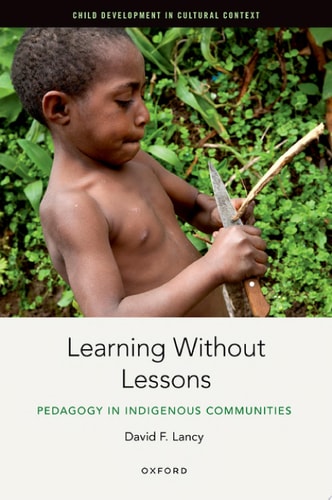
Learning Without Lessons: Pedagogy in Indigenous Communities
0
0
As an Amazon Associate and affiliate partner, Menrva Books earns from qualifying purchases. Learn more
Author Description
In Learning Without Lessons, David F. Lancy fills a rather large gap in the field of child development and education. Drawing on focused, empirical studies in cultural psychology, ethnographic accounts of childhood, and insights from archaeological studies, Lancy offers the first attempt to review the principles and practices for fostering learning in children that are found in small-scale, pre-industrial communities across the globe and through history. His analysis yields a consistent and coherent "pedagogy" that can be contrasted sharply with the taken-for-granted pedagogy found in the West. The practices that are rare or absent from indigenous pedagogy include teachers, classrooms, lessons, verbal instruction, testing, grading, praise, and the use of symbols. Instead, field studies document the prevalence of self-guided learners who rely on observation, listening, learning in play from peers the hands-on use of real tools and, learning through voluntary participation in everyday activities such as foraging. Aiming to reverse the customary relation between western and non-Western theories or ideas about child learning and development, this book concludes that the pedagogy found in communities before the advent of schooling differs in very significant ways from that practiced in schools and in the homes of schooled parents.
Menrva's Summary
THE THESIS
This book investigates the fundamental differences between indigenous learning practices and the formal, Western-centric pedagogy of modern schooling. David F. Lancy, an expert in the anthropology of childhood, synthesizes ethnographic data, archaeological evidence, and cultural psychology to challenge the universality of classroom-based education. He argues that small-scale, pre-industrial societies utilize a distinct, highly effective pedagogy centered on self-guided observation and participation rather than explicit instruction.
THE SCOPE MAP
What You Will Find
- Comparative analysis of pre-industrial versus modern Western educational frameworks
- Ethnographic evidence documenting learning through play, observation, and tool use
- Archaeological insights into historical child development practices
- A critique of standard pedagogical tools such as testing, grading, and verbal instruction
THE AUTHORITY PERSPECTIVE
Experts recognize this work as a significant contribution to the field of educational anthropology for its systematic deconstruction of Western schooling norms. Readers frequently note the academic density of the prose and the breadth of the cross-cultural evidence provided.
Page Count:
296
Publication Date:
2024-01-01
Publisher:
Oxford University Press
ISBN-10:
0197645593
ISBN-13:
9780197645598
Politics
Sociology
Counseling Psychology
Education & Training
Education
Anthropology