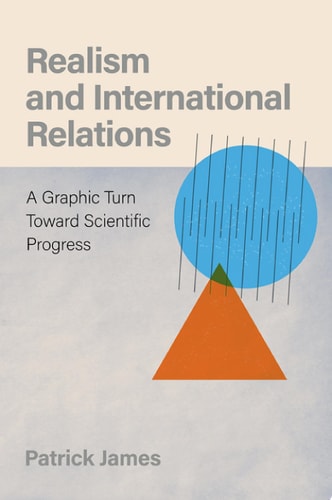
Realism and International Relations: A Graphic Turn Toward Scientific Progress
0
0
As an Amazon Associate and affiliate partner, Menrva Books earns from qualifying purchases. Learn more
Author Description
Realism is one of the core theories within the field of international relations, and it generally posits a state system characterized by anarchy where states act in what they perceive to be their own self interests. It is a controversial theory, and it has many opponents. Yet effective debate among realists and those who identify with other schools of thought has diminished dramatically over time. As Patrick James argues in Realism and International Relations, scholars in the field have become dissatisfied with results from exchanges in words alone. He contends that translation of the vast amount of information in the field into knowledge requires a greater emphasis on communication beyond the use of text. Given the challenges posed by existing and intensifying information overload, he develops a new model that relies on the graphic representation of analytical arguments.As James explains, realist scholarship in the post-World War II era is the natural domain for the application of systemism, a graphic form of expression with straightforward rules for portrayal of analytical arguments, notably cause and effect within theories. Systemism goes beyond prior iterations of systems theory to offer a visualization technique borrowed and adapted from the philosophy of science. Systemist graphics reveal the shortcomings, contributions and potential of realism. These visualizations, which focus on realist theories about war, are intended to bring order out of what critics tend to describe, with some justification, as chaos. In sum, a graphic turn for realism in particular and international relations in general is essential in order to achieve the scientific progress that otherwise is likely to remain elusive. A major theoretical work by an eminent scholar, this will be of interest to all theorists focusing how the international system of states actually functions.
Menrva's Summary
THE THESIS
This work investigates whether the adoption of graphic modeling can resolve the stagnation of theoretical debate within international relations by providing a more rigorous, scientific framework for realist scholarship. Patrick James, a prominent scholar in the field, argues that traditional text-based discourse has failed to manage information overload and clarify causal arguments. He proposes 'systemism'—a visual methodology adapted from the philosophy of science—to map the mechanics of state behavior and realist theories of war. By replacing ambiguous prose with structured graphic representations, the author seeks to facilitate clearer analytical progress and systematic evaluation of international systems.
THE SCOPE MAP
What You Will Find
- A comprehensive application of systemism to post-World War II realist scholarship.
- Methodological rules for the graphic portrayal of cause-and-effect relationships in political theory.
- A critique of current text-based communication standards in international relations research.
- Visualized models focusing on the dynamics of war and state interaction within an anarchic system.
THE AUTHORITY PERSPECTIVE
Experts recognize this text as a specialized contribution to the philosophy of international relations, particularly for those interested in the intersection of political science and formal modeling. Readers often note the high level of academic density, as the book requires familiarity with both realist theory and the specific technical rules of systemist graphics.
Page Count:
646
Publication Date:
2022-01-01
Publisher:
Oxford University Press
ISBN-10:
0197645046
ISBN-13:
9780197645048
Theory
International relations
War Philosophy
Academic
Community Tags
Similar Books