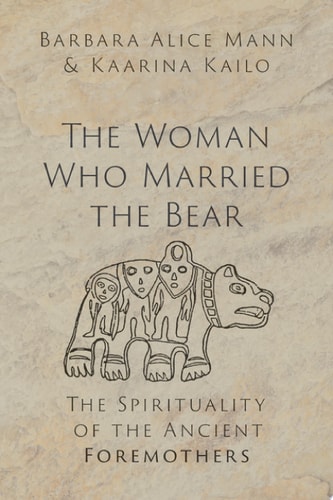
The Woman Who Married the Bear: The Spirituality of the Ancient Foremothers
0
0
As an Amazon Associate and affiliate partner, Menrva Books earns from qualifying purchases. Learn more
Author Description
Stories of the primordial woman who married a bear, appear in matriarchal traditions across the global North from Indigenous North America and Scandinavia to Russia and Korea. In The Woman Who Married the Bear, authors Barbara Alice Mann, a scholar of Indigenous American culture, and Kaarina Kailo, who specializes in the cultures of Northern Europe, join forces to examine these Woman-Bear stories, their common elements, and their meanings in the context of matriarchal culture.The authors reach back 35,000 years to tease out different threads of Indigenous Woman-Bear traditions, using the lens of bear spirituality to uncover the ancient matriarchies found in rock art, caves, ceremonies, rituals, and traditions. Across cultures, in the earliest known traditions, women and bears are shown to collaborate through star configurations and winter cave-dwelling, symbolized by the spring awakening from hibernation followed by the birth of “cubs.” By the Bronze Age, however, the story of the Woman-Bear marriage had changed: it had become a hunting tale, refocused on the male hunter.Throughout the book, Mann and Kailo offer interpretations of this earliest known Bear religion in both its original and its later forms. Together, they uncover the maternal cultural symbolism behind the bear marriage and the Original Instructions given by Bear to Woman on sustainable ecology and lifeways free of patriarchy and social stratification.
Menrva's Summary
THE THESIS
This work investigates the cross-cultural prevalence of the 'Woman Who Married the Bear' myth to determine its role in ancient matriarchal societies and its subsequent transformation into patriarchal hunting narratives. Barbara Alice Mann, an expert in Indigenous American culture, and Kaarina Kailo, a specialist in Northern European traditions, collaborate to analyze 35,000 years of historical and archaeological evidence. They argue that these stories originally functioned as a framework for sustainable ecology and egalitarian social structures before being repurposed by later cultures. The authors utilize a comparative methodology to trace the evolution of bear spirituality from its maternal origins to its later masculine reinterpretation.
THE SCOPE MAP
What You Will Find
- Comparative analysis of bear-related myths across North America, Scandinavia, Russia, and Korea.
- Examination of archaeological evidence including rock art, cave sites, and ritual artifacts.
- Investigation into the transition of bear symbolism from maternal, ecological guidance to male-centric hunting lore.
- Exploration of 'Original Instructions' regarding sustainable living and the rejection of social stratification.
THE AUTHORITY PERSPECTIVE
Scholars and readers note that this text provides a dense, interdisciplinary approach to comparative mythology and gender studies. Experts highlight the book as a significant contribution to understanding how ancient narratives reflect shifting social hierarchies and ecological values.
Page Count:
296
Publication Date:
2023-01-01
Publisher:
Oxford University Press
ISBN-10:
0197655424
ISBN-13:
9780197655429
Spirituality
Sex
Mythology
Cultural History
Anthropology
Community Tags
Similar Books