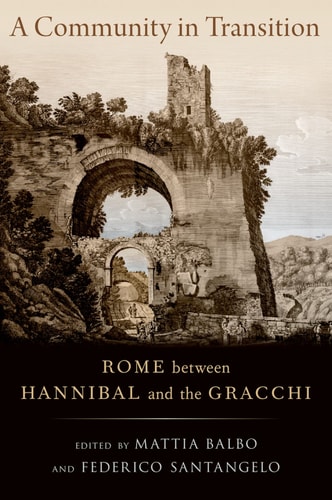
A Community in Transition: Rome between Hannibal and the Gracchi
0
0
As an Amazon Associate and affiliate partner, Menrva Books earns from qualifying purchases. Learn more
Author Description
This volume gathers twelve studies on key aspects of the history of Rome and its empire between the end of the Hannibalic War (200 BCE) and the election of Tiberius Gracchus to the tribunate (134 BCE). Through this periodization, which places the focus on what intervened between two major and well-studied historical turning points in Republican history, the book aims to bring new light to the interplay between imperial expansion, political volatility, and intellectual developments, and on the various levels on which historical change unfolded.The lack of a continuous ancient narrative for this period, even late or derivative, has shaped much of the historiographical discourse about it. This volume seeks to convey a new sense of the depth of the period and establishes new connections among aspects of human agency and action that are usually considered in isolation from one another. It puts in fruitful dialogue contribution on a range of topics as diverse as climate change, oratory, agrarian laws, urban architecture, and the civilian military, among others. The result is a diverse, multifocal, non-hierarchical assessment of a critical but often understudied period in Roman history.With a well-balanced list of established and up-and-coming scholars, A Community in Transition fills a substantial historiographical gap in the study of the Roman Republic.
Menrva's Summary
THE THESIS
This volume investigates the socio-political and cultural evolution of the Roman Republic during the critical, often overlooked interval between the conclusion of the Hannibalic War and the rise of Tiberius Gracchus. Editors Federico Santangelo and Mattia Balbo curate a collection of twelve scholarly studies that challenge traditional historiographical gaps by examining the interplay between imperial expansion, political instability, and intellectual shifts. By synthesizing diverse evidence, the authors argue that this period was not merely a transition but a complex era of human agency and structural change.
THE SCOPE MAP
What You Will Find
- Analysis of the Roman Republic between 200 BCE and 134 BCE.
- Interdisciplinary examination of climate change, oratory, and urban architecture.
- Evaluation of agrarian laws and the civilian military structure.
- A non-hierarchical assessment of historical change through multiple scholarly perspectives.
THE AUTHORITY PERSPECTIVE
Experts identify this collection as a significant contribution to Roman Republican studies, specifically addressing the lack of continuous ancient narratives for this era. Scholars frequently note that the volume successfully bridges the gap between established historical turning points by integrating diverse academic methodologies.
Page Count:
392
Publication Date:
2022-01-01
Publisher:
Oxford University Press
ISBN-10:
0197655262
ISBN-13:
9780197655269
History
Ancient History
Roman Republic
Political History
Community Tags
Similar Books