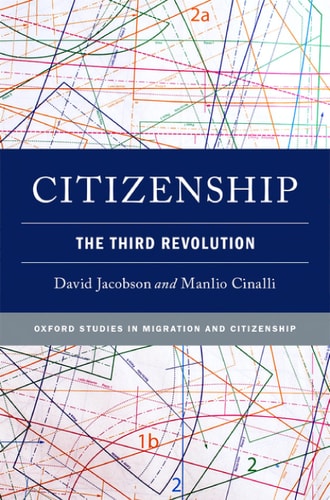
Citizenship: The Third Revolution
0
0
As an Amazon Associate and affiliate partner, Menrva Books earns from qualifying purchases. Learn more
Author Description
The emergence of citizenship, some 4,000 years ago, was a hinge moment in human history. Instead of the reign of blood descent, questions regarding who rules and who belongs were opened up. Yet purportedly primordial categories, such as sex and race, have constrained the emergence of a truly civic polity ever since. Untying this paradox is essential to overcoming the crisis afflicting contemporary democracies. Why does citizenship emerge, historically, and why does it maintain traction, even if in compromised forms? How can citizenship and democracy be revived? Learning from history and building on emerging social and political developments, David Jacobson and Manlio Cinalli provide the foundations for citizenship's third revolution.Citizenship: The Third Revolution considers three revolutionary periods for citizenship, from the ancient and classical worlds; to the flourishing of guilds and city republics from 1,000 CE; and to the unfinished revolution of human rights from the post-World War II period. Through historical enquiry, this book reveals the underlying principles of citizenship-and its radical promise. Jacobson and Cinalli demonstrate how the effective functioning of citizenship depends on human connections that are relational and non-contractual, not transactional. They illustrate how rights, paradoxically, can undermine as well as reinforce civic society. Looking forward, the book documents the emerging foundations of a "21st century guild" as a basis for repairing our democracies. The outcome of this scholarship is an innovative re-conceptualization of core ideas to engender more authentic civic collectivities.
Menrva's Summary
THE THESIS
How can the historical evolution of citizenship inform the resolution of the current crisis facing contemporary democratic systems? David Jacobson and Manlio Cinalli utilize a historical and sociological framework to analyze the development of citizenship across three distinct revolutionary periods. By examining the tension between blood-based hierarchies and civic belonging, the authors argue that the future of democracy depends on shifting from transactional, contract-based rights toward relational, non-contractual human connections.
THE SCOPE MAP
What You Will Find
- A historical analysis of three major revolutionary periods: ancient/classical, medieval city republics, and the post-WWII human rights era.
- A theoretical framework for understanding citizenship as a non-contractual, relational phenomenon.
- An investigation into the paradox where rights-based systems can simultaneously reinforce and undermine civic society.
- A proposal for a 21st-century guild model to serve as a foundation for repairing modern democratic institutions.
THE AUTHORITY PERSPECTIVE
Scholars and political theorists identify this work as a significant contribution to the study of migration and civic belonging. Readers frequently note the academic density of the prose, which serves as a rigorous foundation for understanding the structural challenges facing modern democratic states.
Page Count:
256
Publication Date:
2023-01-01
Publisher:
Oxford University Press
ISBN-10:
0197669158
ISBN-13:
9780197669150
History
Civics
Human rights
Democracy
Sociology
Community Tags
Similar Books