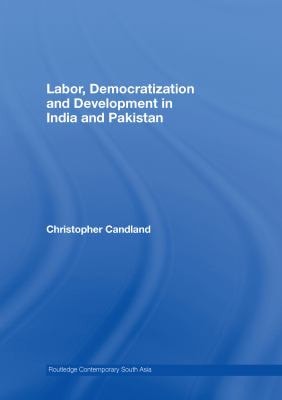
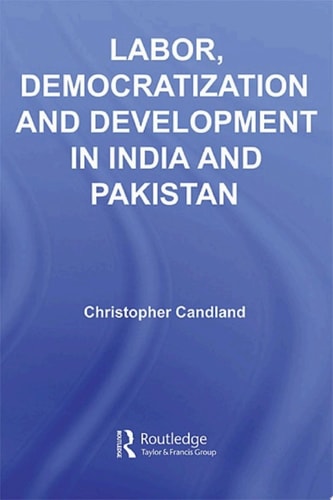
Labor, Democratization and Development in India and Pakistan
0
0
As an Amazon Associate and affiliate partner, Menrva Books earns from qualifying purchases. Learn more
Author Description
The overall argument is that only rights-based organized labor unions can allow “the transformation of wealth into well-being”. Unionism can hence sustain democratization by promoting the redistribution of wealth created through the process of capitalist accumulation. This analysis is welcome as it fills two important gaps in the study of the political economy of development and democracy in South Asia. First, it is one of the very few studies to directly address the issue of organized labor in South Asia. Second, it is an important addition to the rather neglected field of comparative studies between India and Pakistan. Moreover, Christopher Candland must be credited for putting forward a comprehensive understanding of development as a process not limited to economic growth but that includes a continuous improvement of the quality of life of the people, especially the poor, and of democracy, as more than just a set of political institutions and mechanisms, but as a system of governance that ought to deliver on social and economic rights and development in the broadest sense. Finally, he is cautious not to presuppose a causal link between democracy and development while acknowledging that an indirect and somewhat more complex link does exist.
Menrva's Summary
THE THESIS
This book argues that rights-based organized labor unions are essential for transforming wealth into well-being and sustaining democratization in South Asia. The analysis fills critical gaps by directly addressing organized labor in South Asia and offering a comparative study of India and Pakistan. Candland defines development broadly, encompassing not just economic growth but also improved quality of life, particularly for the poor, and views democracy as a governance system that must deliver on social and economic rights. The work cautiously explores the complex, indirect link between democracy and development without presupposing a direct causal relationship.
THE SCOPE MAP
- Analysis of the role of organized labor in the political economy of development and democracy in India and Pakistan.
- Examination of how rights-based labor unions can promote wealth redistribution and social well-being.
- A comparative framework for understanding the distinct yet interconnected trajectories of India and Pakistan.
- A comprehensive definition of development that extends beyond economic growth to include quality of life and social rights.
- An exploration of democracy as a system of governance delivering tangible social and economic outcomes.
- Discussion on the nuanced relationship between democracy and development, avoiding simplistic causal claims.
THE AUTHORITY PERSPECTIVE
The book is recognized for filling significant gaps in the study of South Asian political economy and comparative politics between India and Pakistan. Its comprehensive understanding of development, extending beyond mere economic growth to encompass quality of life and social rights, is particularly noted. The author's cautious approach to the relationship between democracy and development, acknowledging a complex, indirect link rather than a direct causal one, is also a key strength. The work is seen as a valuable contribution to understanding the role of organized labor in fostering both democratization and equitable development.
Page Count:
224
Publication Date:
2011-01-01
Publisher:
Taylor & Francis Group
ISBN-10:
0415428203
ISBN-13:
9780415501927
Non-Fiction
Politics
History
Industrial Relations
Labor Studies
Labor unions
Comparative Politics
Community Tags
Other Editions(5)



Similar Books


Reader Comments
Share Your Thoughts
No comments yet. Be the first to share your thoughts!