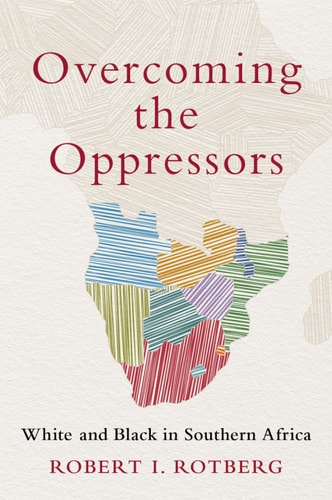
Overcoming the Oppressors: White and Black in Southern Africa
0
0
As an Amazon Associate and affiliate partner, Menrva Books earns from qualifying purchases. Learn more
Author Description
Overcoming the Oppressors traces southern Africa's long walk to freedom, the overturning of colonial rule in the northern territories, and the dissolution of backs-to-the-wall white settler suzerainty, first in what became Zimbabwe and then in South Africa. Chapters on the individual countries detail the stages along their sometimes complicated and tortuous struggle to attain the political New Zion. Rotberg explains how and why the Federation of Rhodesia and Nyasaland failed, how and why apartheid eventually collapsed, and exactly how the various components of this heavily white conquered, and later white oppressed, domain transitioned via diverse fits and starts into today's assemblage of proud, politically charged, and still mostly fragmented nation-states. But what did the new republics make of their hard-won freedoms? Having liberated themselves successfully, several soon dismantled democratic safeguards, established effective single-party states, closed their economies, deprived citizens of human rights and civil liberties, and exchanged economic progress for varieties of central planning experiments and stunted forms of protected economic endeavors. Only Botswana, of the new entities, embraced full democracy and good governance. The others, even South Africa, at first tightly regimented their economies and attempted to severely limit the degrees of economic freedom and social progress that citizens could enjoy. Corruption prevailed everywhere except Botswana. Today, as the chapters on contemporary southern Africa reveal, most of the southern half of the African continent is returning, if sometimes struggling, to the patterns of probity and good governance that many countries abandoned in the decades after independence.
Menrva's Summary
THE THESIS
This work investigates the complex political and economic transition of southern African nations from colonial rule and white minority regimes to independence and the subsequent challenges of governance. Robert I. Rotberg, a scholar of African politics, utilizes historical analysis and political evaluation to examine the collapse of colonial structures in Zimbabwe and South Africa. He argues that while liberation was achieved, the post-independence period was marked by a widespread abandonment of democratic safeguards and economic mismanagement, with Botswana serving as a notable exception to these trends.
THE SCOPE MAP
What You Will Find
- Historical analysis of the dissolution of white settler suzerainty in Zimbabwe and South Africa.
- Comparative study of post-independence governance models across southern African states.
- Examination of economic policies, including central planning and the restriction of civil liberties.
- Assessment of contemporary trends toward probity and democratic governance in the region.
THE AUTHORITY PERSPECTIVE
Experts recognize this text as a comprehensive historical account of the political evolution of southern Africa. Readers frequently note the author's critical approach to the failures of post-colonial leadership and the nuanced distinction between the region's various national trajectories.
Page Count:
432
Publication Date:
2023-01-01
Publisher:
Oxford University Press
ISBN-10:
0197674224
ISBN-13:
9780197674222
History
Colonialism
Decolonization
Apartheid
African
Africa - History
International relations
Community Tags
Similar Books