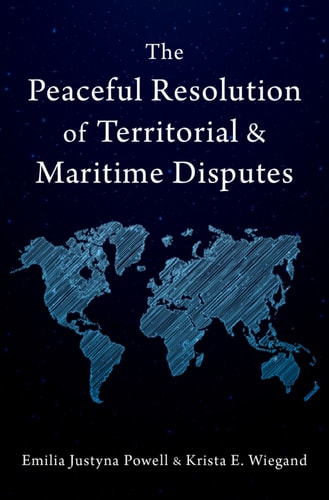
The Peaceful Resolution of Territorial and Maritime Disputes
0
0
As an Amazon Associate and affiliate partner, Menrva Books earns from qualifying purchases. Learn more
Author Description
This book is about the peaceful resolution (PR) of territorial and maritime disputes and states' strategic behavior vis-à-vis methods of peaceful resolution: bilateral negotiations, good offices, inquiry, conciliation, mediation, arbitration, and adjudication. The authors argue that the high stakes associated with settlement of territorial and maritime disputes, the diversity of PR methods employed, and unpredictability of outcomes push states to strategize. Strategic considerations undergird states' choice of the particular PR methods, and states' behavior during the resolution once a particular method such as adjudication or negotiations, has been initiated. Uncertainty about the outcome drives states to pursue "strategic selection." The process of strategic selection occurs at two interrelated stages: the initial pursuit of a particular method and venue--choice-of-venue strategic selection, and decision-making once a PR method/venue has been identified--within-venue strategic selection. The driving force behind strategizing in these two settlement stages is the hope of reducing uncertainty and of increasing the chances of winning. Importantly, as the disputants progress through the settlement process, states reconsider and refine these strategies.For each stage of strategic selection, Powell and Wiegand identify several mechanisms that influence states' strategies, including past experiences with PR methods (winning/losing), the relationship between domestic law and international law, framing legal claims, and shaping the resolution procedures. This book embraces a multi-method approach and combines statistical analyses and in-depth qualitative interviews with states' legal counsel, judges, arbitrators, government officials, and other experts from multiple countries. The book also highlights numerous real-world instances of territorial and maritime disputes including the Philippines v. China arbitration case in the South China dispute.
Menrva's Summary
THE THESIS
This book investigates how states strategically select and navigate methods for the peaceful resolution of territorial and maritime disputes to minimize uncertainty and maximize favorable outcomes. Authors Krista E. Wiegand and Emilia Justyna Powell utilize a combination of quantitative statistical analysis and qualitative data to examine the decision-making processes of nations. They argue that states engage in a two-stage process of 'strategic selection'—choosing a venue and then managing the proceedings—to influence the trajectory of international legal disputes. By analyzing the interplay between domestic and international law, the authors provide a framework for understanding why states choose specific resolution methods like arbitration, mediation, or bilateral negotiation.
THE SCOPE MAP
What You Will Find
- A comprehensive analysis of peaceful resolution methods including arbitration, adjudication, mediation, and conciliation.
- The theoretical framework of 'choice-of-venue' and 'within-venue' strategic selection.
- Empirical evidence derived from statistical models and in-depth interviews with judges, legal counsel, and government officials.
- Case studies of high-stakes international conflicts, including the Philippines v. China arbitration regarding the South China Sea.
THE AUTHORITY PERSPECTIVE
Experts recognize this work as a significant contribution to the study of international law and state behavior. Scholars frequently note the rigor of the multi-method approach, which effectively bridges the gap between abstract political theory and the practical realities of international litigation.
Page Count:
288
Publication Date:
2023-01-01
Publisher:
Oxford University Press
ISBN-10:
0197675662
ISBN-13:
9780197675663
Conflict Resolution
Law
International relations
Diplomacy
Community Tags
Similar Books