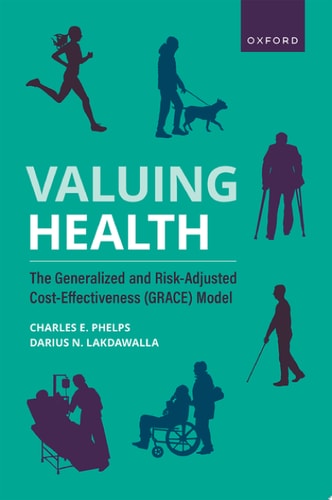
Valuing Health: The Generalized and Risk-Adjusted Cost-Effectiveness (GRACE) Model
0
0
As an Amazon Associate and affiliate partner, Menrva Books earns from qualifying purchases. Learn more
Author Description
Cost-effectiveness analysis (CEA) plays an important role in health policy debates, helping to shape resource allocation and pricing decisions. Yet many economists also recognize that the current framework can offer misleading and incomplete results. Current CEA methods imply that health improvements are equally valuable to those in good health and poor health, which fails to recognize the increased value of health improvements for those with severe illness or disability.Valuing Health introduces the generalized risk-adjusted cost-effectiveness (GRACE) model as a more accurate method for determining the value of medical treatments and technologies. The GRACE model generalizes the underlying CEA assumption of constant gains in health care, demonstrating through diminishing returns the greater economic value of improving the quality of life for individuals with disability or severe illness. Valuing Health also provides sensitivity analyses to show how value measurements change alongside key parameters, including the potential effects of various combinations of risk preferences on the aggregate value of treating a defined population with any set of available treatments. It concludes with a discussion of the ethical differences between the CEA and GRACE methods and outlines steps for implementing the GRACE model to replace standard CEA as the proper method for valuing medical interventions.Valuing Health offers a revelatory reconceptualization of current valuation models in health economics with clear guidance for inclusive pricing and regulation that reflects the true value of modern health care.
Menrva's Summary
THE THESIS
How can health economics evolve to accurately measure the value of medical treatments for individuals with severe illness or disability? Charles E. Phelps and Darius N. Lakdawalla, both established experts in health economics, argue that traditional cost-effectiveness analysis (CEA) relies on flawed assumptions regarding the uniform value of health gains. They propose the Generalized Risk-Adjusted Cost-Effectiveness (GRACE) model, which incorporates diminishing returns to account for the higher economic value of health improvements in populations with significant pre-existing health burdens.
THE SCOPE MAP
What You Will Find
- A critique of standard CEA frameworks and their limitations in resource allocation.
- The mathematical and conceptual structure of the GRACE model.
- Sensitivity analyses demonstrating how risk preferences alter the valuation of medical interventions.
- Ethical comparisons between traditional CEA and the proposed GRACE methodology.
THE AUTHORITY PERSPECTIVE
Experts identify this work as a significant contribution to the field of health economics, specifically for its attempt to reconcile economic efficiency with equity concerns. Readers frequently note the technical density of the prose, which is intended for policy analysts, economists, and healthcare administrators.
Page Count:
328
Publication Date:
2024-01-01
Publisher:
Oxford University Press
ISBN-10:
019768629X
ISBN-13:
9780197686294
Economics
Finance
Medical Ethics
Public Health
Health Policy
Community Tags
Similar Books