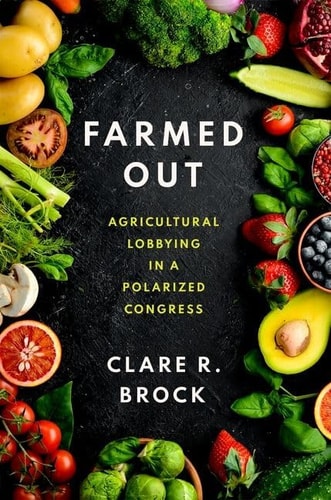
Farmed Out: Agricultural Lobbying in a Polarized Congress
0
0
As an Amazon Associate and affiliate partner, Menrva Books earns from qualifying purchases. Learn more
Author Description
Interest groups have a tremendous impact on public policy. Congressional capacity for research and fact-finding is at a historical low, and interest groups have rushed in to fill the gap. They effectively act as adjunct staffers by providing members of Congress with the necessary information to write legislation. Of course, none of this is done for free. Lobbying groups influence the content of policy in ways that further their own agendas. How have interest groups modified their strategies in response to the newly polarized and information-sparse political climate? And what are the implications for interest groups' influence over the content of policy?In Farmed Out, Clare R. Brock uses U.S. agricultural policy as a vehicle to explain how the rapidly polarizing political environment has altered the role of interest groups in Washington. Drawing on over two decades of lobbying behavior data in the agricultural sector, Brock argues that polarization has given interest groups greater influence over policy content, particularly among their ideological and partisan allies. Brock's findings suggest that lobbyists increasingly work on an extended time horizon, often with cross-cutting coalitions, in order to pursue policy outcomes that once might have been easy asks. As a result, lobbying influence appears to increasingly be skewed toward those interest groups who have the capacity to maintain a long-term presence on the Hill--in other words, affluent and relatively wealthy groups whose concerns might not reflect the preferences of most Americans. Farmed Out makes an important and original contribution to our understanding of how interest groups now operate within a context of heightened polarization, lengthened time horizons, and declining institutional capacity.
Menrva's Summary
THE THESIS
How has the increase in political polarization and the decline of congressional research capacity altered the influence and strategies of agricultural interest groups? Clare R. Brock, a scholar of American politics, investigates the symbiotic relationship between lobbyists and legislators in an era of information scarcity. By analyzing two decades of lobbying data, she argues that polarization has empowered interest groups to act as de facto legislative staff, thereby skewing policy outcomes toward the agendas of well-resourced, long-term lobbying coalitions.
THE SCOPE MAP
What You Will Find
- Longitudinal analysis of over twenty years of lobbying behavior data within the U.S. agricultural sector.
- Examination of the shift toward extended time horizons in lobbying strategy.
- Assessment of how cross-cutting coalitions are utilized to secure policy outcomes in a polarized environment.
- Evaluation of the disparity in influence between affluent interest groups and the broader public interest.
THE AUTHORITY PERSPECTIVE
Experts identify this work as a significant contribution to the study of legislative influence and institutional decay in the modern Congress. Readers frequently note the academic rigor of the data analysis, which provides a clear framework for understanding how interest groups navigate contemporary political polarization.
Page Count:
192
Publication Date:
2023-01-01
Publisher:
Oxford University Press
ISBN-10:
0197683797
ISBN-13:
9780197683798
Politics
Specific Topics
Sociology
Government
Public Policy
Agriculture
Elections & Political Process
Community Tags
Similar Books