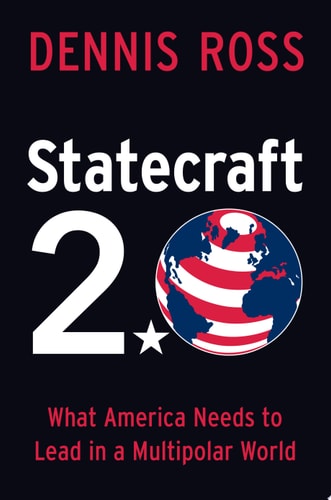
Statecraft 2.0: What America Needs to Lead in a Multipolar World
0
0
As an Amazon Associate and affiliate partner, Menrva Books earns from qualifying purchases. Learn more
Author Description
In a world that is multipolar and America has less relative power, the United States no longer has the luxury to practice statecraft badly.The United States may still be the world's strongest country, but it now faces real challenges at both a global and regional level. The unipolar world which was dominated by America after the Cold War is gone. Unlike the Soviet Union, China is both a military and economic competitor and it is actively challenging the norms and institutions that the US used to shape an international order during and after the Cold War. Directly and indirectly, it has partners trying to undo the American-dominated order, with Russia seeking to extinguish Ukraine, and Iran trying to undermine American presence, influence, and any set of rules for the Middle East that it does not dominate.The failures of American policy in Afghanistan and Iraq have weakened the domestic consensus for a US leadership role internationally. Traditions in US foreign policy, especially the American sense of exceptionalism, have at different points justified both withdrawal and international activism. Iraq and Afghanistan fed the instinct to withdraw and to end the "forever wars." But the folly of these US interventions did not necessarily mean that all use of force to back diplomacy or specific political ends was wrong; rather it meant in these cases, the Bush Administration failed in the most basic task of good statecraft: namely, marrying objectives and means. Nothing more clearly defines effective statecraft than identifying well-considered goals and then knowing how to use all the tools of statecraft--diplomatic, economic, military, intelligence, information, cyber, scientific, education--to achieve them. But all too often American presidents have adopted goals that were poorly defined and not thought through.In Statecraft 2.0, a significant update of the first edition, Dennis Ross explains why failing to marry objectives and means has happened so often in American fo
Menrva's Summary
THE THESIS
This book investigates how the United States can effectively align its strategic objectives with available national tools to maintain global influence in an increasingly multipolar environment. Dennis Ross, a veteran diplomat with extensive experience in Middle East peace negotiations and national security policy, draws upon decades of high-level government service to analyze the failures of recent American foreign policy. He argues that the primary cause of decline is not a lack of power, but a consistent failure to match realistic goals with the appropriate application of diplomatic, economic, and military resources.
THE SCOPE MAP
What You Will Find
- Analysis of the transition from a unipolar post-Cold War order to a complex multipolar landscape.
- Evaluation of the strategic failures in Afghanistan and Iraq regarding the alignment of means and ends.
- A comprehensive framework for utilizing the full spectrum of statecraft tools, including cyber, intelligence, and economic leverage.
- Examination of how domestic political consensus impacts the sustainability of American international leadership.
THE AUTHORITY PERSPECTIVE
Experts and policy analysts recognize this work as a pragmatic manual for modern statecraft that emphasizes the necessity of disciplined goal-setting. Readers frequently note the clarity of the author's arguments, which provide a sober assessment of the limitations and requirements of American power in the current century.
Page Count:
496
Publication Date:
2025-03-05
Publisher:
Oxford University Press
ISBN-10:
0197698921
ISBN-13:
9780197698921
History
Politics
World politics
Government
International relations
Foreign Policy
Community Tags
Similar Books