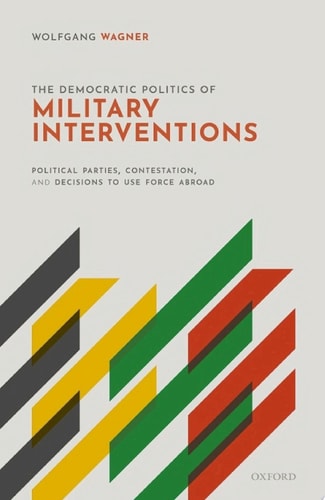
The Democratic Politics of Military Interventions: Political Parties, Contestation, and Decisions to Use Force Abroad
0
0
As an Amazon Associate and affiliate partner, Menrva Books earns from qualifying purchases. Learn more
Author Description
According to a widely shared notion, foreign affairs are exempted from democratic politics, i.e. party-political divisions are overcome-and should be overcome-for the sake of a common national interest. This book shows that this is not the case. Examining votes in the US Congress and several European parliaments, the book demonstrates that contestation over foreign affairs is barely different from contestation over domestic politics. Analyses of a new collection of deployment votes, of party manifestos, and of expert survey data show that political parties differ systematically over foreign policy and military interventions in particular. The left/right divide is the best guide to the pattern of party-political contestation: support is weakest at the far left of the spectrum and increases as one moves along the left/right axis to green, social democratic, liberal and conservative parties; amongst parties of the far right, support is again weaker than amongst parties of the centre. An analysis of parliamentary debates in Canada, Germany, and the United Kingdom about the interventions in Afghanistan and against Daesh in Iraq and Syria shows that political parties also differ systematically in how they frame the use of force abroad. For example, parties on the right tend to frame their country's participation in the US-led missions in terms of national security and national interests whereas parties on the left tend to engage in 'spiral model thinking', i.e. they critically reflect on the unintended consequences of the use of force in fuelling the conflicts with the Taliban and Daesh.
Menrva's Summary
THE THESIS
This book investigates whether foreign policy, specifically military intervention, is truly exempt from domestic partisan politics or if it follows the same patterns of contestation as internal policy issues. Wolfgang Wagner, a scholar of international relations, utilizes a comparative framework to challenge the notion of a unified national interest in foreign affairs. By analyzing parliamentary voting records, party manifestos, and expert surveys, the author argues that political parties maintain systematic, predictable differences regarding the use of force abroad based on their position along the left-right ideological spectrum.
THE SCOPE MAP
What You Will Find
- Quantitative analysis of deployment votes in the US Congress and various European parliaments.
- Comparative study of party manifestos and expert survey data regarding foreign policy.
- Qualitative analysis of parliamentary debates in Canada, Germany, and the United Kingdom.
- Examination of specific military interventions, including operations in Afghanistan and against Daesh in Iraq and Syria.
Scope Limits
- The study focuses primarily on Western democratic systems and may not account for non-democratic or non-parliamentary decision-making processes.
- The analysis is restricted to the specific interventions mentioned and does not cover every instance of global military engagement.
THE AUTHORITY PERSPECTIVE
Scholars in the field of international relations recognize this work as a rigorous empirical challenge to the traditional consensus-based model of foreign policy. Readers frequently note the academic density of the prose and the systematic nature of the author's comparative methodology.
Page Count:
189
Publication Date:
2020-01-01
Publisher:
OUP Oxford
ISBN-10:
0192586025
ISBN-13:
9780192586025
Comparative Politics
Foreign Policy
International relations
Government
Military History
Public Policy
Community Tags
Similar Books