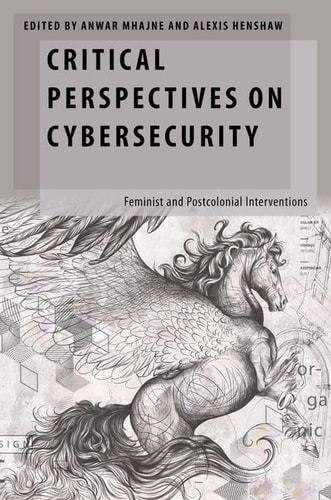
Critical Perspectives on Cybersecurity: Feminist and Postcolonial Interventions
0
0
As an Amazon Associate and affiliate partner, Menrva Books earns from qualifying purchases. Learn more
Author Description
Traditional notions of national security have generally dominated cybersecurity debates, but the response to emerging cybersecurity issues should not merely focus on the militarization of cyberspace. Weaponizing a space heavily populated by civilians has enormous implications for human rights. Yet, cybersecurity studies in international relations have largely overlooked the impact of cybersecurity policies on individuals and communities--including the consequences of surveillance, data overcollection, cybercrime, and cyberbullying.Critical Perspectives on Cybersecurity offers a new approach to understanding cybersecurity in international relations. As a counterpoint to existing work, which focuses largely on the security of states, private actors, and infrastructure, chapter authors examine how women and communities across the Global South understand "cybersecurity," including what threats and forms of resistance are most important to them. They make the case that policies need to consider individual human rights by putting people's empowerment and wellbeing at their center. Drawing on feminist and postcolonial theory, the chapters also cover issues that challenge conventional notions of cybersecurity, including disinformation, gender-based violence online, and technology as a neocolonial force. Bringing together contributions from a globally diverse range of authors, Anwar Mhajne and Alexis Henshaw provide a human security perspective on cybersecurity that pays attention to the interplay of race, ethnicity, gender, class, and other social hierarchies, especially regarding cybersecurity in the Global South.
Menrva's Summary
THE THESIS
This book investigates how traditional, state-centric cybersecurity frameworks fail to account for the lived experiences of individuals and marginalized communities, particularly within the Global South. Authors Alexis Henshaw and Anwar Mhajne, both scholars in international relations and security studies, curate a collection of essays that apply feminist and postcolonial lenses to digital policy. They argue that the current militarized approach to cyberspace ignores human rights, surveillance impacts, and the neocolonial dimensions of technology, advocating instead for a human-centric security model that prioritizes individual well-being over state infrastructure protection.
THE SCOPE MAP
What You Will Find
- Analysis of cybersecurity through the lenses of feminist and postcolonial theory.
- Examination of digital threats including disinformation, online gender-based violence, and data overcollection.
- Case studies focusing on the Global South and the intersectionality of race, class, and gender in digital spaces.
- A critique of state-centric security policies and the militarization of cyberspace.
THE AUTHORITY PERSPECTIVE
Experts identify this work as a significant contribution to the field of international relations for its departure from traditional security paradigms. Readers frequently note the academic density of the prose, which serves as a foundational text for those seeking to understand the social and political implications of digital policy.
Page Count:
216
Publication Date:
2024-01-01
Publisher:
Oxford University Press
ISBN-10:
0197695884
ISBN-13:
9780197695883
Politics
International relations
Feminist Theory
Technology and Society
Cybersecurity
Specific Topics
Elections & Political Process
Community Tags
Similar Books