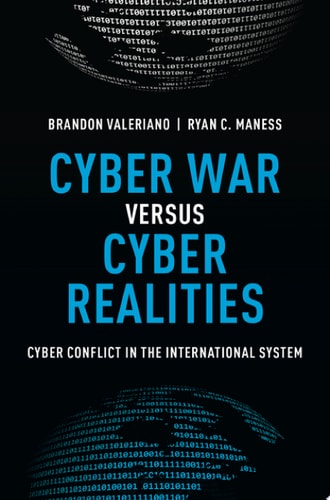
Cyber War versus Cyber Realities: Cyber Conflict in the International System
0
0
As an Amazon Associate and affiliate partner, Menrva Books earns from qualifying purchases. Learn more
Author Description
In 2011, The United States Government Declared A Cyber Attack As Equal To An Act Of War, Punishable With Conventional Military Means. Cyber Operations, Cyber Crime, And Other Forms Of Cyber Activities Directed By One State Against Another Are Now Considered Part Of The Normal Relations Range Of Combat And Conflict, And The Rising Fear Of Cyber Conflict Has Brought About A Reorientation Of Military Affairs. What Is The Reality Of This Threat? Is It Actual Or Inflated, Fear Or Fact-based? Taking A Bold Stand Against The Mainstream Wisdom, Valeriano And Maness Argue That There Is Very Little Evidence That Cyber War Is, Or Is Likely To Become, A Serious Threat. Their Claim Is Empirically Grounded, Involving A Careful Analysis Of Cyber Incidents And Disputes Experienced By International States Since 2001, And An Examination Of The Processes Leading To Cyber Conflict. As The Authors Convincingly Show, Cyber Incidents Are A Little-used Tactic, With Low-level Intensity And Few To No Long-term Effects. As Well, Cyber Incidents Are Motivated By The Same Dynamics That Prompt Regional Conflicts. Based On This Evidence, Valeriano And Maness Lay Out A Set Of Policy Recommendations For Proper Defense Against Cyber Threats That Is Built On Restraint And Regionalism.
Menrva's Summary
THE THESIS
This book investigates whether the prevailing fear of cyber warfare as a catastrophic threat to international security is supported by empirical evidence or if it is largely an inflated narrative. The authors, Brandon Valeriano and Ryan C. Maness, utilize their expertise in international relations and security studies to challenge the conventional wisdom surrounding state-sponsored cyber operations. By analyzing data on cyber incidents and disputes between nations since 2001, they argue that cyber conflict remains a low-intensity, infrequent tactic that does not warrant the current level of alarm or the shift toward conventional military responses.
THE SCOPE MAP
What You Will Find
- A comprehensive dataset of international cyber incidents and disputes occurring between 2001 and the book's publication.
- An analysis of the strategic motivations behind state-sponsored cyber activities.
- A framework for understanding cyber conflict through the lens of traditional international relations theory.
- Policy recommendations advocating for restraint and regional cooperation in cyber defense.
Scope Limits
- The analysis focuses primarily on state-on-state cyber conflict and does not extensively cover non-state actor cybercrime or private sector vulnerabilities.
- The study does not account for technological developments or geopolitical shifts occurring after the book's primary research period.
THE AUTHORITY PERSPECTIVE
Experts in international security frequently cite this work as a critical counter-narrative to the alarmist rhetoric common in cybersecurity policy discussions. Readers often note the academic rigor of the authors' empirical approach, which provides a necessary, data-driven foundation for debates on modern warfare.
Page Count:
266
Publication Date:
2015-01-01
Publisher:
Oxford University Press
ISBN-10:
0190204818
ISBN-13:
9780190204815
Politics
History
Specific Topics
Military Strategy
Kindle Store
Kindle eBooks
Cybersecurity
International relations
Categories
World politics
Community Tags
Similar Books