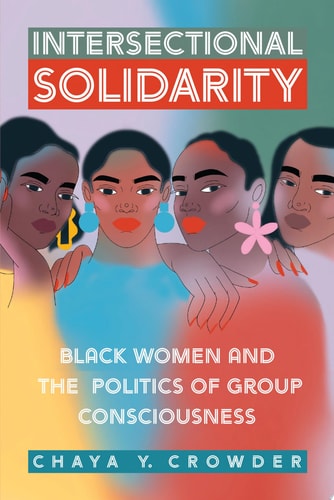
Intersectional Solidarity: Black Women and the Politics of Group Consciousness
0
0
As an Amazon Associate and affiliate partner, Menrva Books earns from qualifying purchases. Learn more
Author Description
Black women have been credited for Democratic wins in a number of recent consequential elections. Yet outside of the post-election glow, Black women's interests tend not to attract a great deal of attention from politicians, media, or the public more broadly. In Intersectional Solidarity, Chaya Y. Crowder looks at the question of what prompts people to prioritize issues that affect Black women, and when? In particular, she challenges the notion that racial or gender consciousness alone shape political preferences and instead argues that intersectional group consciousness shapes political behavior. Crowder argues that a combination of race, gender, sexuality, and class-based consciousness influences political behavior, particularly when it comes to issues that affect individuals at the intersection of multiple marginalized identities. Further, she introduces the idea of "intersectional solidarity," informed by work in social psychology, political science, and Black feminist theory. Crowder applies intersectional solidarity to all people, regardless of their race, gender, or sexuality, but she uses it particularly to explore what groups demonstrate solidarity with Black women, and why. Intersectional Solidarity demonstrates that in order to fully understand how people come to care about issues that affect Black women, scholars are required to ask new questions.
Menrva's Summary
THE THESIS
What factors drive individuals to prioritize the political interests of Black women, and how does intersectional group consciousness influence these preferences? Chaya Y. Crowder, a scholar in political science, examines the limitations of viewing political behavior through the singular lenses of race or gender. By synthesizing frameworks from social psychology, political science, and Black feminist theory, she argues that intersectional group consciousness—a combination of race, gender, sexuality, and class—is the primary driver of political behavior regarding marginalized identities.
THE SCOPE MAP
What You Will Find
- An analysis of intersectional group consciousness as a predictor of political behavior.
- The conceptual framework of intersectional solidarity applied across diverse demographic groups.
- Examination of how political interests of Black women are addressed by media, politicians, and the public.
- Integration of social psychology and Black feminist theory to explain political coalition building.
THE AUTHORITY PERSPECTIVE
Experts identify this work as a significant contribution to the study of political behavior and identity politics. Scholars frequently note the clarity with which Crowder bridges the gap between theoretical intersectionality and empirical political science research.
Page Count:
208
Publication Date:
2025-02-06
Publisher:
Oxford University Press
ISBN-10:
0197696546
ISBN-13:
9780197696545
Politics
Sociology
Black studies
Feminist Theory
Womens Studies
American Politics
Community Tags
Similar Books