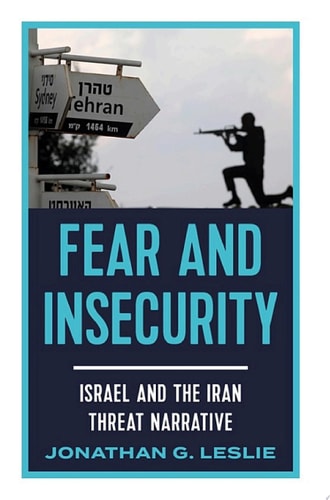
Fear and Insecurity: Israel and the Iran Threat Narrative
0
0
As an Amazon Associate and affiliate partner, Menrva Books earns from qualifying purchases. Learn more
Author Description
To observers of the Iran-Israel conflict, its vitriolic rhetoric might suggest an ancient hatred between Jews and Muslims-a biblical feud dating back hundreds, or thousands, of years. But this rivalry is a far more modern development.In this authoritative study, Jonathan G. Leslie examines the origins of the conflict. Drawing on extensive archival and open-source research, he concludes that-despite the animosity surrounding the Iran-Israel relationship-the twenty-first century's hostilities are not inevitable consequences of these nations' history, nor of contemporary political events. The intensification of tensions has been largely the product of one nation's efforts, with Israel viewing Iran as a far greater danger than Iran does Israel. Using a novel theoretical approach considering the power of narrative within historical context, Leslie outlines how Israel's leaders successfully reimagined their erstwhile ally Iran as an existential threat. Former Prime Minister Benjamin Netanyahu took this further, employing populist strategies in an attempt to rewrite history, depict Iran as a global menace, and recruit allies against the JCPOA nuclear deal.Fear and Insecurity provides important new insights into the history of the Iran-Israel conflict, and offers fresh prospects for defusing the tensions threatening both global and regional security.
Menrva's Summary
THE THESIS
This study investigates whether the contemporary hostility between Israel and Iran is an inevitable historical outcome or a constructed political narrative. Jonathan G. Leslie, an expert in regional security, utilizes extensive archival and open-source research to challenge the notion of an ancient, deep-seated feud. He argues that the current state of conflict is primarily the result of deliberate strategic framing by Israeli leadership, specifically during the tenure of Benjamin Netanyahu, to position Iran as an existential threat to national security.
THE SCOPE MAP
What You Will Find
- Historical analysis of the shifting diplomatic relationship between Israel and Iran from historical allies to modern adversaries.
- Theoretical framework examining the role of political narratives in shaping international security perceptions.
- Examination of populist strategies used to influence public opinion and international policy regarding the JCPOA nuclear deal.
- Evaluation of how threat perception is manufactured and maintained within a geopolitical context.
THE AUTHORITY PERSPECTIVE
Experts and political analysts recognize this work as a significant contribution to the study of Middle Eastern security dynamics. Readers frequently note the academic rigor of the research and the clarity with which the author deconstructs complex diplomatic strategies.
Page Count:
457
Publication Date:
2022-01-01
Publisher:
Oxford University Press
ISBN-10:
0197695485
ISBN-13:
9780197695487
History
Middle Eastern
Comparative Politics
Middle East
Geopolitics
International relations
Comparative Government
Modern History
Community Tags
Similar Books