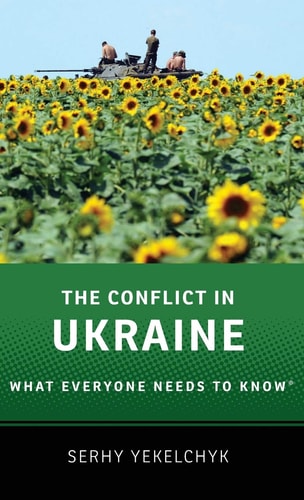
The Conflict in Ukraine: What Everyone Needs to Know
0
0
As an Amazon Associate and affiliate partner, Menrva Books earns from qualifying purchases. Learn more
Author Description
When guns began firing again in Europe, why was it Ukraine that became the battlefield? Conventional wisdom dictates that Ukraine's current crisis can be traced to the linguistic differences and divided political loyalties that have long fractured the country. However this theory only obscures the true significance of Ukraine's recent civic revolution and the conflict's crucial international dimension. The 2013-14 Ukrainian revolution presented authoritarian powers in Russia with both a democratic and a geopolitical challenge. President Vladimir Putin reacted aggressively by annexing the Crimea and sponsoring the war in eastern Ukraine; and Russia's actions subsequently prompted Western sanctions and growing international tensions reminiscent of the Cold War. Though the media portrays the situation as an ethnic conflict, an internal Ukrainian affair, it is in reality reflective of a global discord, stemming from differing views on state power, civil society, and democracy.The Conflict in Ukraine: What Everyone Needs to Know explores Ukraine's contemporary conflict and complicated history of ethnic identity, and it does do so by weaving questions of the country's fraught relations with its former imperial master, Russia, throughout the narrative. In denying Ukraine's existence as a separate nation, Putin has adopted a stance similar to that of the last Russian tsars, who banned the Ukrainian language in print and on stage. Ukraine emerged as a nation-state as a result of the imperial collapse in 1917, but it was subsequently absorbed into the USSR. When the former Soviet republics became independent states in 1991, the Ukrainian authorities sought to assert their country's national distinctiveness, but they failed to reform the economy or eradicate corruption. As Serhy Yekelchyk explains, for the last 150 years recognition of Ukraine as a separate nation has been a litmus test of Russian democracy, and the Russian threat to Ukraine will remain in place for as long as
Menrva's Summary
THE THESIS
What are the historical and geopolitical drivers behind the ongoing conflict between Ukraine and Russia? Serhy Yekelchyk, a professor of history and Slavic studies, utilizes his expertise to dismantle the narrative that the conflict is merely an internal ethnic struggle. He argues that the crisis is a manifestation of a broader global discord regarding state power and democracy, rooted in Russia's historical refusal to recognize Ukrainian sovereignty.
THE SCOPE MAP
What You Will Find
- Analysis of the 2013-14 Ukrainian revolution and its impact on Russian geopolitical strategy
- Historical overview of Ukrainian statehood from the 1917 imperial collapse to the post-Soviet era
- Examination of the role of corruption and economic reform in modern Ukrainian politics
- Discussion of the ideological parallels between modern Russian policy and Tsarist-era suppression
Scope Limits
- Does not provide a minute-by-minute tactical account of military engagements
- Focuses primarily on the political and historical context rather than individual human interest stories
THE AUTHORITY PERSPECTIVE
Experts and readers frequently cite this work as a foundational text for understanding the historical roots of the Russo-Ukrainian conflict. The prose is noted for its accessibility, making complex geopolitical history clear for a general audience while maintaining academic rigor.
Page Count:
208
Publication Date:
2015-09-03
Publisher:
Oxford University Press
ISBN-10:
0190237279
ISBN-13:
9780190237271
History
Ukraine history
Comparative Politics
Regionalism
Politics & Government
International relations
Ukraine
Geopolitics
Group Identity
Russia
Community Tags
Other Editions(2)
Similar Books

Reader Comments
Share Your Thoughts
No comments yet. Be the first to share your thoughts!