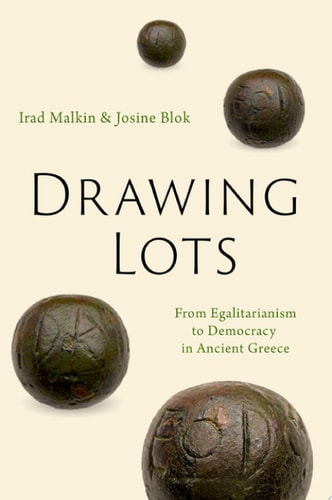
Drawing Lots: From Egalitarianism to Democracy in Ancient Greece
0
0
As an Amazon Associate and affiliate partner, Menrva Books earns from qualifying purchases. Learn more
Author Description
For the first time, this volume by two leading historians offers a comprehensive study of drawing lots as a central institution of ancient Greek society. Drawing lots expressed an egalitarian mindset that guided selection, procedure, and distribution by lot and was eventually introduced for polis governance, a Greek innovation that appears to be of increasing relevance today.The authors explore the egalitarian, "horizonal," mindset expressed in using the lot instead of a top-down vision of authority and sovereignty. Drawing lots presupposed equality among participants deserving equal "portions" and was used for distributing land, inheritance, booty, sacrificial meat, selecting individuals, setting turns, mixing and reorganizing groups, and divining the will of the gods. Lot-oracles were used for divination; otherwise, the gods guarded the justice of the procedure but only rarely determined the outcome. It was a self-evident method broadly and ubiquitously applied. Drawing lots would crystallize community boundaries and emphasize its sovereignty. The book further investigates the transposition of the drawing of lots to the governance of the polis. The implied egalitarianism of the lot often conflicted with top-down perceptions of society and the values of inequality, status, and merit. Drawing lots was introduced into oligarchies and democracies at an uneven pace and scale. Its wide use in the democracy of classical Athens was an exceptional case, eye-catching both in antiquity and today.The book concludes with a discussion about the meaning of the Greek examples for drawing lots today and the increasing interest in using random selection in politics as a possibility for modern democracies around the world. The appendix surveys the Greek vocabulary of lottery practices.
Menrva's Summary
THE THESIS
This volume investigates the historical function and political significance of sortition, or the drawing of lots, as a foundational egalitarian mechanism in ancient Greek society. Authors Irad Malkin and Josine Blok, both established historians of the ancient world, synthesize archaeological and textual evidence to argue that the lot was not merely a randomizing tool but a deliberate expression of horizontal social organization. They examine how this practice evolved from a method of fair distribution into a sophisticated instrument of governance that challenged traditional hierarchies of merit and status.
THE SCOPE MAP
What You Will Find
- A comprehensive analysis of sortition practices ranging from land distribution and inheritance to the selection of public officials.
- An exploration of the philosophical tension between egalitarian lot-based systems and top-down oligarchic structures.
- A detailed examination of the Athenian democratic model and its unique reliance on random selection for political office.
- An appendix providing a linguistic survey of the Greek vocabulary associated with lottery and procedural practices.
THE AUTHORITY PERSPECTIVE
Scholars and historians recognize this work as a definitive study on the institutional role of the lot in the development of Greek political thought. Readers frequently note the academic rigor of the prose, which provides a valuable framework for contemporary discussions regarding the potential for sortition in modern democratic systems.
Page Count:
536
Publication Date:
2024-01-01
Publisher:
Oxford University Press
ISBN-10:
0197753477
ISBN-13:
9780197753477
History
Ancient Greece
Democracy
Sociology
Community Tags
Similar Books