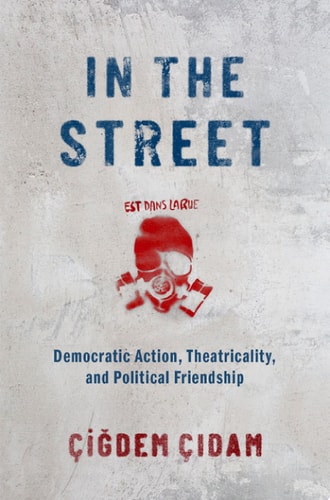
In the Street: Democratic Action, Theatricality, and Political Friendship
0
0
As an Amazon Associate and affiliate partner, Menrva Books earns from qualifying purchases. Learn more
Author Description
If there is one thing that people agree about concerning the massive, leaderless, spontaneous protests that have spread across the globe over the past decade, it's that they were failures. The protesters, many claim, simply could not organize; nor could they formulate clear demands. As a result, they failed to bring about long-lasting change.In the Street challenges this seemingly forgone conclusion. It argues that when analyses of such events are confined to a framework of success and failure, they lose sight of the on-the-ground efforts of political actors who demonstrate, if for a fleeting moment, that another way of being together is possible. The conception of democratic action developed here helps us see that events like Occupy Wall Street, the Gezi uprising, or the weeks-long protests that took place all around the US after George Floyd's killing by the police are best understood as democratic enactments created in and through "intermediating practices," which include contestation, deliberation, judging, negotiation, artistic production, and common use. Through these intermediating practices, people become "political friends"; they act in ways other than expected of them to reach out to others unlike themselves, establish relations with strangers, and constitute a common amidst disagreements. These democratic enactments are fleeting, but what remains in their aftermath are new political actors and innovative practices.The book demonstrates that the current obsession with the "failure" of spontaneous protests is the outcome of a commonly accepted way of thinking about democratic action, which casts organization as a technical matter that precedes politics and moments of spontaneous popular action as sudden explosions. The origins of this widely shared understanding lie in Jean-Jacques Rousseau's conception of popular sovereignty, shaped by his rejection of theatricality and idealization of immediacy. Insofar as contemporary thinkers see democratic moments as t
Menrva's Summary
THE THESIS
This book investigates whether the perceived failure of spontaneous, leaderless protests is a result of flawed analytical frameworks rather than the actions of the protesters themselves. Çiğdem Çıdam, a scholar of political theory, challenges the conventional metrics of success and failure that dominate contemporary discourse on global uprisings. By re-evaluating the relationship between democratic action and theatricality, she argues that these movements should be understood as democratic enactments that foster new forms of political friendship and commonality.
THE SCOPE MAP
What You Will Find
- A critique of the Rousseauian influence on modern conceptions of popular sovereignty.
- An analysis of 'intermediating practices' such as deliberation, judging, and artistic production.
- Case studies of movements including Occupy Wall Street, the Gezi uprising, and the 2020 US protests.
Scope Limits
- The text does not provide a manual for organizational strategy or institutional reform.
- It does not focus on the long-term legislative outcomes of the movements discussed.
THE AUTHORITY PERSPECTIVE
Scholars in political theory identify this work as a significant intervention in the study of spontaneous political action. Readers frequently note the dense, theoretical nature of the prose, which requires familiarity with democratic theory to fully grasp the author's arguments.
Page Count:
264
Publication Date:
2021-04-30
Publisher:
Oxford University Press
ISBN-10:
0190071680
ISBN-13:
9780190071684
Politics
History
Special Topics
Educational Resources
Politics & Government
Sociology
Democracy
New Used & Rental Textbooks
Political Theory
Community Tags
Similar Books