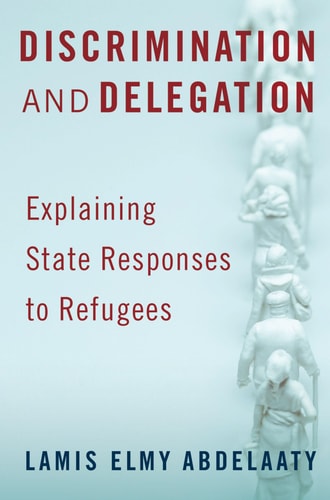
Discrimination and Delegation: Explaining State Responses to Refugees
0
0
As an Amazon Associate and affiliate partner, Menrva Books earns from qualifying purchases. Learn more
Author Description
What explains the variety of responses that states adopt toward different refugee groups? Refugees might be granted protection or turned away; they might be permitted to live where they wish and earn an income, pursue education, and access medical treatment; or, they might be confined to a camp and forced to rely on aid while being denied basic services. However, states do not consistently wield their capacity for control, nor do they jealously guard their authority to regulate.In this book, Lamis Elmy Abdelaaty asks why states sometimes assert their sovereignty vis-à-vis refugee rights and at other times seemingly cede it by delegating refugee oversight to the United Nations. To explain this selective exercise of sovereignty, Abdelaaty develops a two-part theoretical framework in which policymakers in refugee-receiving countries weigh international and domestic concerns. Policymakers in a receiving country might decide to offer protection to refugees from a rival country in order to undermine the sending country's stability, saddle it with reputation costs, and even engage in guerilla-style cross-border attacks. At the domestic level, policymakers consider political competition among ethnic groups--welcoming refugees who are ethnic kin of citizens can satisfy domestic constituencies, expand the base of support for the government, and encourage mobilization along ethnic lines. When these international and domestic incentives conflict, the state shifts responsibility for refugees to the UN, which allows policymakers to placate both refugee-sending countries and domestic constituencies.Abdelaaty analyzes asylum admissions worldwide, and then examines three case studies in-depth: Egypt (a country that is broadly representative of most refugee recipients), Turkey (an outlier that has limited the geographic application of the Refugee Convention), and Kenya (home to one of the largest refugee populations in the world). Discrimination and Delegation argues that foreign pol
Menrva's Summary
THE THESIS
This book investigates the underlying political motivations that drive state-level variation in the treatment and management of refugee populations. Lamis Elmy Abdelaaty, a scholar of international relations, utilizes a combination of global quantitative data and targeted qualitative case studies to argue that state responses are not arbitrary. Instead, she posits that policymakers navigate a complex calculus involving international strategic rivalries and domestic ethnic politics, often delegating authority to the United Nations when these competing pressures become irreconcilable.
THE SCOPE MAP
What You Will Find
- A theoretical framework analyzing the intersection of international strategic interests and domestic ethnic composition.
- Comparative analysis of asylum policies across diverse global contexts.
- In-depth case studies focusing on the specific administrative and political environments of Egypt, Turkey, and Kenya.
- An examination of the conditions under which states choose to assert sovereignty versus delegating oversight to international organizations.
THE AUTHORITY PERSPECTIVE
Experts in political science and migration studies identify this work as a significant contribution to understanding the intersection of state sovereignty and humanitarian policy. Readers frequently note the clarity of the author's theoretical framework and the effectiveness of the selected case studies in illustrating complex geopolitical dynamics.
Page Count:
248
Publication Date:
2023-01-01
Publisher:
Oxford University Press
ISBN-10:
0197753388
ISBN-13:
9780197753385
Politics
Government Policy
Human rights
International relations
World politics
New Used & Rental Textbooks
Public Policy
Specific Topics
Sovereignty
Comparative Politics
Community Tags
Similar Books