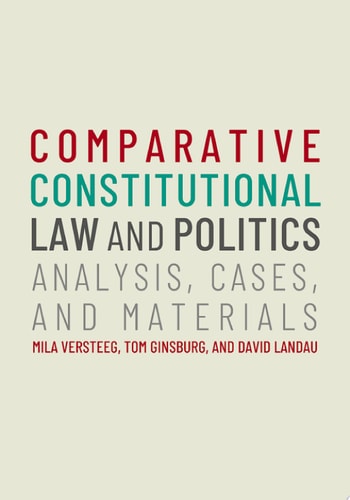
Comparative Constitutional Law and Politics: Analysis, Cases, & Materials
0
0
As an Amazon Associate and affiliate partner, Menrva Books earns from qualifying purchases. Learn more
Author Description
This Textbook Takes A New Approach To The Study Of Comparative Constitutional Law, Suitable For Law And Social Science Courses At Graduate Or Undergraduate Levels. First, It Is Interdisciplinary And Seeks To Integrate State-of-the-art Literature And Caselaw From Comparative Constitutional Law With Insights From Social Science. It Uses Quantitative Evidence To Identify Trends In Constitutional Texts And Practices. Second, It Is Global In Scope, Recognizing That Constitution-making And Constitutional Interpretation Are Increasingly Transnational Practices. This Textbook Includes Many Cases And Judicial Decisions. However, It Situates Those Decisions In Their Social And Political Contexts And Includes Excerpts From Scholarly Works, As Well As Detailed Explanations And Citations. The Textbook Aims To Broaden The Field Of Comparative Constitutional Law Far Beyond The Usual Suspects. The Reader Will Find Examples Not Only From North America And Europe, But Also From Understudied Jurisdictions In Africa, Asia, And Latin America. This Textbook Has 14 Chapters. Chapter 1 Introduces The Foundational Concepts Of Constitutions And Constitutionalism, While Chapters 2 And 3 Look At Constitution-making And Constitutional Change. Chapters 5, 6, And 7 Consider Issues Related To State Structure - The Horizontal Separation Of Powers, States Of Emergency, And Federalism. Chapter 8 Introduces Key Overarching Issues In Rights Interpretation, While Chapters 9 Through 12 Cover Selected Rights Issues: Freedom Of Speech, Pluralism, Equality, And Economic And Social Rights. Chapter 13 Discusses Key Issues Related To Elections, Voting, And The Protection Of Democracy, While Chapter 14 Looks At The Many Ways In Which Constitutions Interact With International Law-- Provided By Publisher.
Menrva's Summary
THE THESIS
This textbook investigates how constitutional law functions as a dynamic, transnational political practice rather than a static set of legal rules. The authors, David E. Landau, Mila Versteeg, and Tom Ginsburg, leverage their expertise in legal scholarship and social science to bridge the gap between traditional case law and empirical political analysis. By integrating quantitative data with qualitative judicial decisions, the text provides a framework for understanding how constitutions are drafted, interpreted, and enforced across diverse global jurisdictions.
THE SCOPE MAP
What You Will Find
- Quantitative analysis of global trends in constitutional texts and practices.
- Interdisciplinary integration of legal case law with social science research.
- Comparative case studies spanning North America, Europe, Africa, Asia, and Latin America.
- Structured examination of constitutional mechanics including separation of powers, federalism, rights interpretation, and international law interactions.
THE AUTHORITY PERSPECTIVE
Legal scholars and educators frequently highlight this text for its departure from Western-centric legal analysis in favor of a truly global perspective. Experts note that the inclusion of quantitative data makes it a robust resource for both law students and social science researchers seeking to understand the political dimensions of constitutionalism.
Page Count:
832
Publication Date:
2025-09-08
Publisher:
Oxford University Press
ISBN-10:
0197760481
ISBN-13:
9780197760482
Politics
Constitutional Law
textbook
Systems Theory
Law
International relations
Community Tags
Similar Books