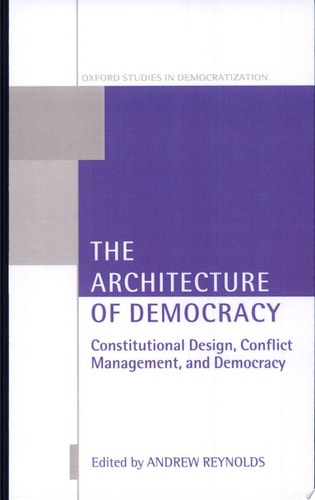
The Architecture of Democracy: Constitutional Design, Conflict Management, and Democracy
0
0
As an Amazon Associate and affiliate partner, Menrva Books earns from qualifying purchases. Learn more
Author Description
Democratic design is increasingly seen as the key to crafting stability in the fragile states of the developing world. Getting the democratic institutions right may not guarantee success but getting them wrong has led to violent collapse in many socially divided states. The Architecture of Democracy brings together both theory and case study evidence to provide the reader with an excellent overview of the cutting edge of academic debate and its practical implications for democratic design in the 21st century. The discipline of constitutional engineering reached maturity in the 1990s with theories of ethnic polarization and democratic conflict management being applied in trouble spots across the globe. Andrew Reynolds brings together the leading lights of the discipline to discuss the successes and failures of constitutional design. The two icons of modern constitutional design, Arend Lijphart and Donald Horowitz, lead off by debating their own contributions to the field. Then Olga Shvetsova, Timothy Frye, and José Antônio Cheibub, present important new evidence from Europe, the Central and Eastern Europe/Asia, and Latin America. Steven Solnick, Yash Ghai, Pippa Norris, and Rein Taagepera analyze the effects of presdential and parliamentary systems, issues of federalism and autonomy, and the varying impact of electoral systems. The book concludes with Brij Lal's case study of Fiji, Brendan O'Leary on Northern Ireland, Bereket Habte Selassie on Eritrea, William Liddle on Indonesia, Rotimi Suburu and Larry Diamond on Nigeria, and David Stuligross and Ashutosh Varshney on India. The Architecture of Democracy is the culmination of the study of constitutional engineering in the third wave of democracy and sets parameters for this crucial research as democracy diffuses across the world.
Menrva's Summary
THE THESIS
This volume investigates whether specific constitutional designs and institutional frameworks can effectively foster stability and prevent violent collapse in socially divided states. Andrew Reynolds, a scholar of political science and democratization, compiles research from leading experts to evaluate the practical application of constitutional engineering. The text synthesizes theoretical debates with empirical case studies to determine how electoral systems, federalism, and executive structures influence the success of democratic transitions in the 21st century.
THE SCOPE MAP
What You Will Find
- Comparative analysis of presidential versus parliamentary systems.
- Theoretical frameworks regarding ethnic polarization and conflict management.
- Case studies covering diverse regions including Fiji, Northern Ireland, Eritrea, Indonesia, Nigeria, and India.
- Examination of electoral systems and their impact on democratic stability.
Scope Limits
- The text focuses primarily on the 'third wave' of democratization and may not account for the most recent shifts in global digital governance or populist movements.
- It does not provide a universal blueprint for all states, acknowledging that institutional success is highly context-dependent.
THE AUTHORITY PERSPECTIVE
Experts recognize this collection as a foundational text for understanding the intersection of constitutional design and conflict resolution. Readers frequently note the academic density of the prose, which serves as a comprehensive resource for students and practitioners of political science.
Page Count:
507
Publication Date:
2002-01-01
Publisher:
Oxford University Press
ISBN-10:
0191529850
ISBN-13:
9780191529856
International relations
DESIGN General
Professional Career & Trade
Government
Constitutional Law
Public Policy
Community Tags
Other Editions(2)
Similar Books













Reader Comments
Share Your Thoughts
No comments yet. Be the first to share your thoughts!